Cortexa Ground Truth
Nº 15 · Explainer · · 5 min read

Tip: once it’s playing, tap any line to jump the audio there.
Reasoning models show their work.
A reasoning model works the problem out before answering. That thinking costs time and tokens: worth it on genuinely hard tasks, wasted on easy ones.
“Should we put this on one of the new thinking models?” It comes up on nearly every Artificial Intelligence (AI) build now. A reasoning model works a problem out before it answers, the way a careful person scribbles on scratch paper instead of blurting the first thing that comes to mind. That extra step is real, and it earns its keep on genuinely hard problems. On easy ones it mostly just runs up the bill.
What does a reasoning model do differently?
A standard model answers in one pass. It predicts the reply straight through, left to right, closer to autocomplete with a diploma than to a deliberate thinker. A reasoning model puts a step in front of that answer. OpenAI says its models use internal reasoning tokens before producing a response1, which lets them inspect alternatives, recover from ambiguity, and solve harder multi-step tasks1. Google describes the same move: with a thinking model, Gemini reasons internally before responding2. None of this is new. A 2022 paper found that writing out a series of intermediate reasoning steps3 (a chain of thought) significantly improves the ability of large language models to perform complex reasoning3, and that these abilities emerge naturally in sufficiently large language models3.
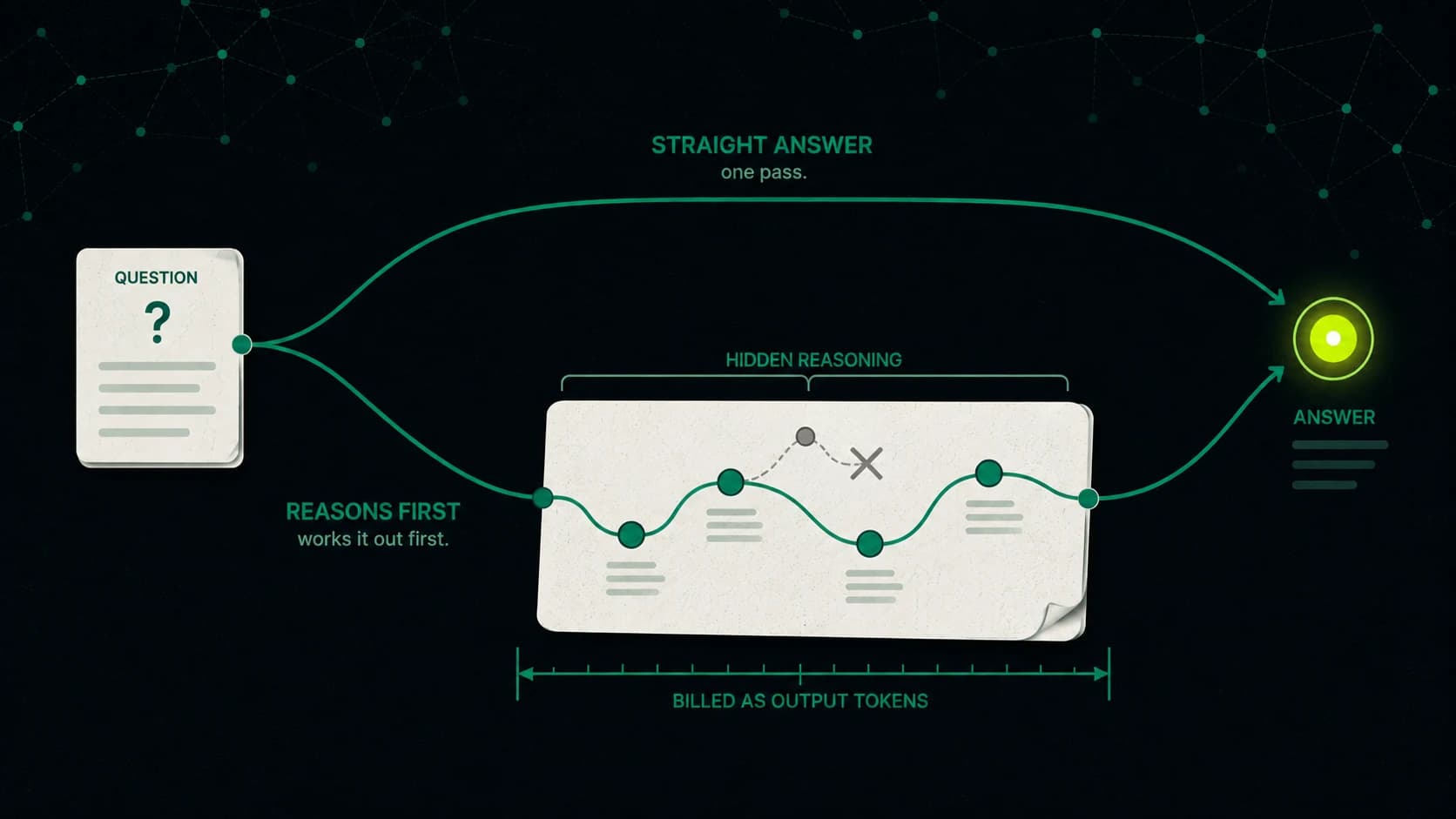
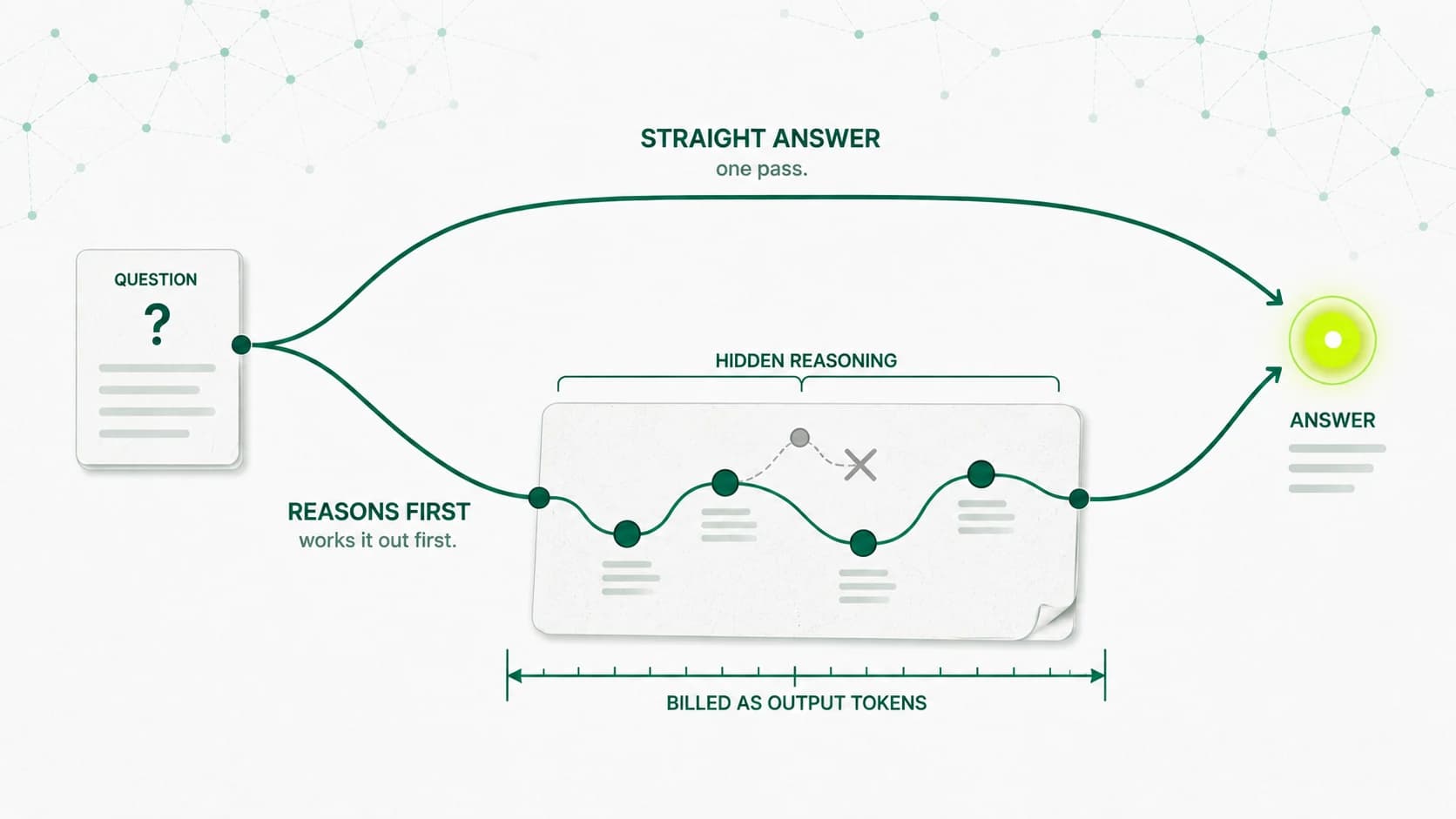
How does a reasoning model reach an answer?
Read
the question comes in, the same as for any model
Think
work through the problem privately, generating hidden reasoning tokens
Check
weigh approaches and catch its own missteps
Answer
return only the conclusion, not the scratch work
The harder the problem, the more hidden thinking it does; every one of those tokens is billed.
What's Real?
- The gains are real, and they cluster on hard, multi-step work. OpenAI says reasoning models are for complex problem solving, coding, scientific reasoning, and multi-step agentic workflows1; Google points to complex tasks such as coding, advanced mathematics, and data analysis2. It's the same effect the 2022 chain-of-thought work measured: room to lay out the steps helps most when the steps are the hard part.
- The cost is real, and it's counted in tokens you never see. The hidden reasoning is metered. OpenAI notes those tokens are not visible via the API1 yet are still billed as output tokens1; Google prices a thinking request as the sum of output tokens and thinking tokens2; Anthropic bills the same way and warns of diminishing returns that depend on the task, and at the cost of increased latency4. Priced in tokens, exactly as the token brief laid out5, a thinking step can cost several times a plain answer.
- On easy problems, the extra thinking can backfire. Researchers named it “overthinking,” where excessive computational resources are allocated for simple problems with minimal benefit6. OpenAI's own guidance agrees: for latency-critical tasks that do not benefit from any reasoning1, leave it off. A plain model is often the right call.
- The visible “reasoning” is not a transcript of the truth. Anthropic found no specific reason why the reported Chain-of-Thought must accurately reflect the true reasoning process7; in one study, a substantial majority of answers7 were unfaithful. The steps read like an explanation. Treat them as a story the model tells about its answer, not an audit log of how it got there.
The “so what” — for anyone serving tech clients
- Match the model to the step, and price it that way. Reserve reasoning for the genuinely hard, high-stakes work: the thorny analysis, the tricky bit of code, the plan a person will act on. Run the routine steps on a plain, faster, cheaper model. Because the hidden thinking is billed as output1 and priced in tokens5, quoting “put it all on the thinking model” can quietly multiply a client's bill for output nobody reads.
- When a client asks for “explainable AI,” be precise about what the reasoning trace is. It looks like an audit trail, and it demos beautifully, but the model's own account of its steps is not guaranteed to be faithful7. When correctness has to be provable, the proof is a test you run, the kind the evals brief describes8, not the story the model narrates about itself.
Sources
- OpenAI — Reasoning models (API guide)
- Google AI for Developers — Gemini thinking
- Wei et al. — Chain-of-Thought Prompting Elicits Reasoning in Large Language Models (preprint)
- Anthropic — Extended thinking (Claude Docs)
- Cortexa Ground Truth Nº 5 — “What a ‘token’ is, and why it’s on your invoice”
- Chen et al. — Do NOT Think That Much for 2+3? On the Overthinking of o1-Like LLMs (preprint)
- Anthropic — Reasoning models don't always say what they think
- Cortexa Ground Truth Nº 8 — “Evals, in plain English”
Next Reads
- Explainer5 min read
To be cited by AI, be worth quoting.
AI assistants answer by pulling live web pages and quoting them. The way to get cited is to be the clearest, best-sourced page on the question.
- Explainer5 min read
Guardrails work in layers.
No single control makes an AI guaranteed brand-safe. The honest answer is layers: steer it, screen it, filter it, and keep a person on the last mile.


