Cortexa Ground Truth
Nº 17 · Explainer · · 5 min read

Tip: once it’s playing, tap any line to jump the audio there.
Guardrails work in layers.
No single control makes an AI guaranteed brand-safe. The honest answer is layers: steer it, screen it, filter it, and keep a person on the last mile.
“Can you promise it'll never say anything off-brand?” Any agency putting Artificial Intelligence (AI) in front of a client's audience gets asked this. A straight yes would be a lie. What you can offer is a set of controls people call guardrails, and the real work is knowing what each one catches and what slips past. Stack enough of them and the odds get very good. No single one is a guarantee.
What is a guardrail, really?
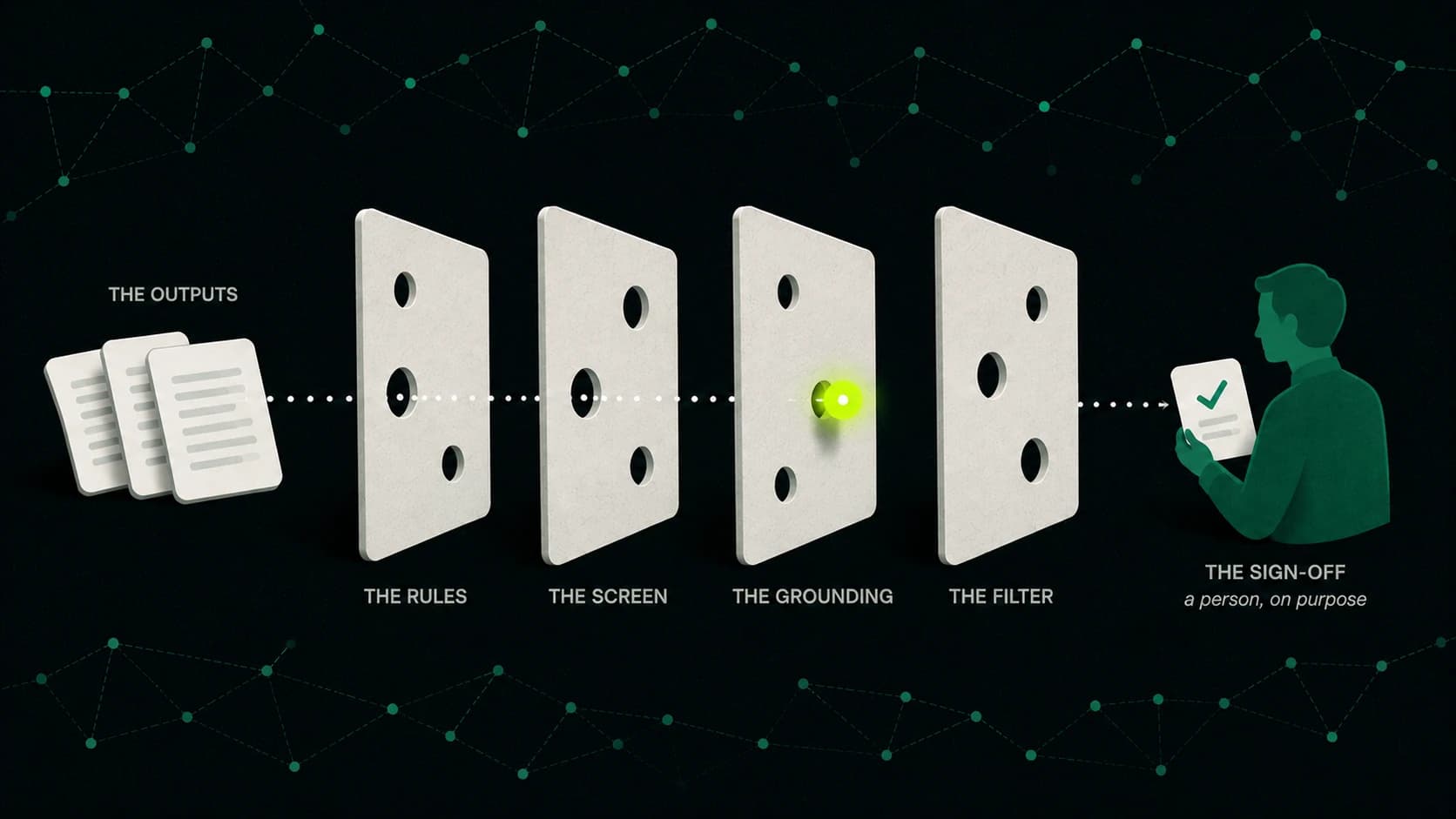
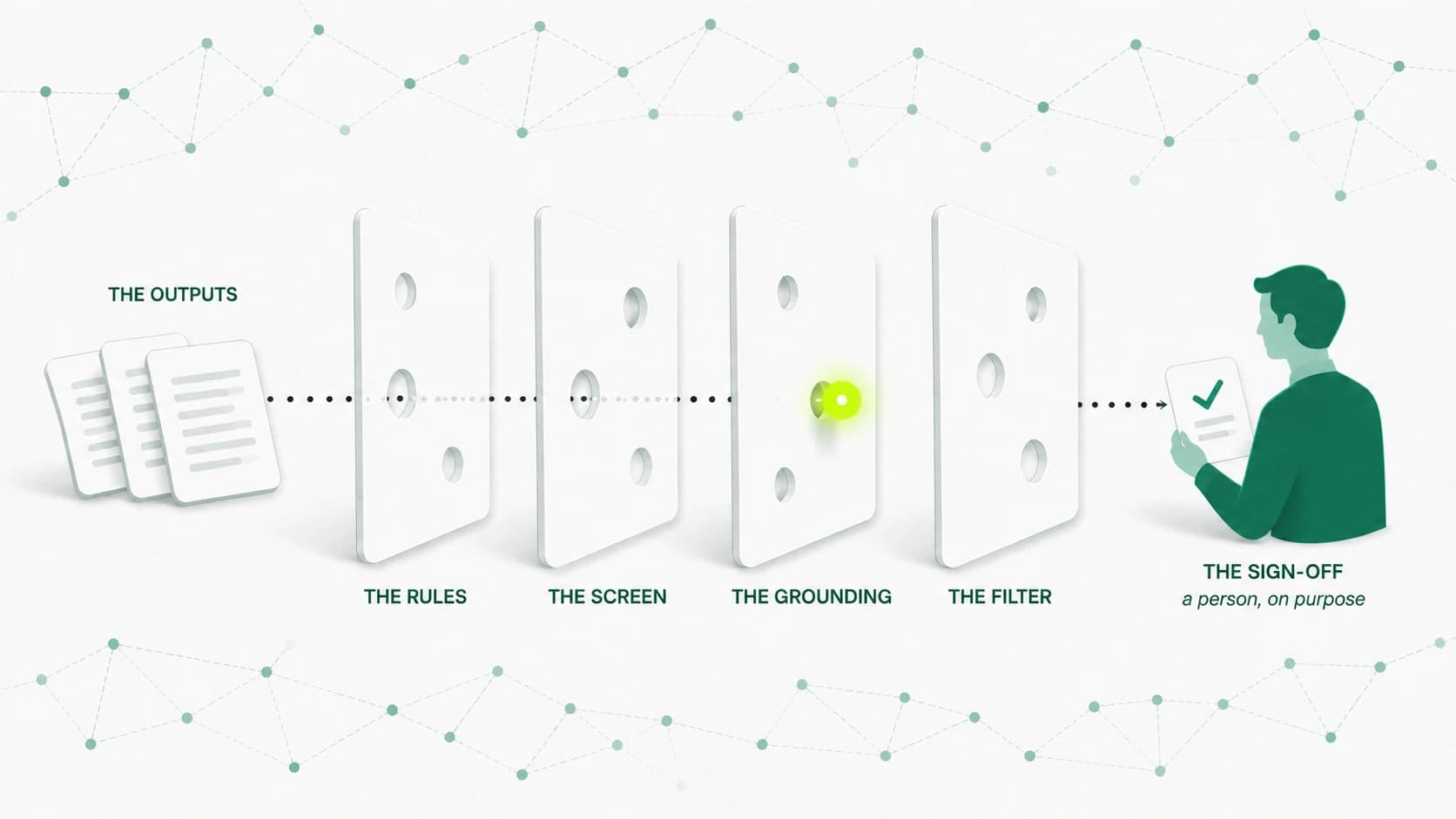
Safety engineers have a picture for this, and it fits AI exactly. Imagine each control as a screen standing in the model's path, and every screen has holes. One screen stops most of what hits it and lets the odd thing slip through. Stack four, with the holes in different places, and almost nothing threads them all. Aviation and medicine have run on this idea for decades; nobody calls any single screen a wall. AI guardrails work the same way. Each shapes what the model tends to do and blunts the worst outcomes, and the value is in the stack, where a gap in one is covered by the next.
What's on the menu of controls?
There is no one guardrail. There's a short menu, and a good setup uses most of it at once. Some vendors package the layers into toolkits: NVIDIA's NeMo Guardrails, for instance, is an open-source toolkit for easily developing safe and trustworthy LLM conversational systems6 that bundles topical, safety, and security rails. Whether you assemble the layers yourself or reach for a toolkit, the same handful of checks does the work.
Set the rules
the system prompt gives the model your tone, your limits, and how to refuse
Screen the input
a classifier checks the request before the model sees it
Ground the answer
hand it the approved source so it quotes instead of guessing
Filter the output
a second classifier scans the reply for policy breaches
Human sign-off
a person approves anything that carries a client's name
Each layer catches some of what the one before it missed; the last layer is a person, on purpose.
What's Real?
- The system prompt steers; it doesn't lock. The instructions you write shape tone and refusals, and they genuinely help. They can also be talked around. In OWASP's list of top risks for large language model (LLM) apps, the first is prompt injection, where user prompts alter the LLM's behavior or output in unintended ways1. OWASP is blunt about the limit: it is unclear if there are fool-proof methods of prevention1. Anthropic treats the system prompt as one layer among several, advising teams to craft system prompts that emphasize ethical and legal boundaries4 and to screen inputs on the way in.
- Filters catch categories, not your brand. Content classifiers are real and cheap. OpenAI's moderation endpoint is free to use2 and flags content across thirteen categories, among them harassment, hate, self-harm, sexual, and violence. Google's Gemini blocks by the probability of content being unsafe3 across categories you can tune. They're good at policy-level harm. They don't know that your client never says “cheap,” or that a competitor's name is off-limits. Brand-safe is a narrower target than “not toxic.”
- Grounding cuts made-up claims, and leaves tone alone. When the danger is the model stating something false, the fix is giving it the source to read, the open-book move from the RAG explainer7. It invents less when it can look the answer up, which is the whole point of understanding why AI guesses8 in the first place. Grounding does nothing for a snippy tone or a leaked instruction. It aims at facts, and only facts.
- No layer is a wall, so the last one is a person. Every control here is a probability with holes in it. That's why OWASP recommends you implement human-in-the-loop controls for privileged operations1, and why the US standards body frames safety as ongoing work rather than a setting you flip once: its voluntary AI Risk Management Framework5 organizes the job into govern, map, measure, and manage. For anything a client will see, human review is the backstop the other layers lean on.
The “so what” — for anyone serving tech clients
- Layer the controls, and say so in the scope. When you propose an AI feature, name the guardrails you're putting on it: the system prompt, the input screen, the grounding, the output filter, the human review. Each is a line item, and each closes a different gap. A proposal with one control and a promise is the tell of a partner who hasn't shipped this before.
- Budget for the human on the last mile. The automatic layers are the cheap ones; the layer that catches what they miss is a named person's time. Price it in. For anything a client's audience will read, sign-off is the human-in-the-loop control OWASP calls for1, and it's the honest difference between “we lowered the risk” and “we checked.”
- Be straight about what “brand-safe” means. It means the risk is reduced and reviewed, not that a bad line is impossible. Clients who serve their own big customers respect that more than a promise nobody can keep. When a filter blocks something, you can point to the platform's own rules to explain the coverage: OpenAI publishes its thirteen categories2, and Google lets you set the thresholds3.
Sources
- OWASP — LLM01:2025 Prompt Injection (Gen AI Security Project)
- OpenAI — Moderation (API guide)
- Google AI for Developers — Gemini safety settings
- Anthropic — Mitigate jailbreaks and prompt injections (Claude Docs)
- NIST — AI Risk Management Framework
- NVIDIA — NeMo Guardrails: safe and trustworthy LLM conversational systems (developer blog)
- Cortexa Ground Truth Nº 3 — “RAG is just giving AI an open book”
- Cortexa Ground Truth Nº 2 — “AI doesn't lie — it guesses confidently”
Next Reads
- Explainer5 min read
Read an AI benchmark like a test score.
A benchmark score says how a model did on one fixed test, under one set of choices. It doesn't say how it will do on your client's job.
- Explainer5 min read
AI video is ready for the storyboard, not the shoot.
AI can generate a cinematic clip with sound in minutes. That's a fast way to show an idea, and a risky way to ship a finished ad.


