Cortexa Ground Truth
Nº 16 · Explainer · · 5 min read

Tip: once it’s playing, tap any line to jump the audio there.
To be cited by AI, be worth quoting.
AI assistants answer by pulling live web pages and quoting them. The way to get cited is to be the clearest, best-sourced page on the question.
“How do we show up when someone asks ChatGPT about our client?” A year ago the question was your rank on Google, the long game of search engine optimization (SEO). Now it is whether an Artificial Intelligence (AI) assistant names you at all when it answers. The honest answer is less mysterious than the hype suggests: these assistants read the live web and quote what they find, so you earn a citation by being the page most worth quoting.
What is a generative engine doing when it answers?
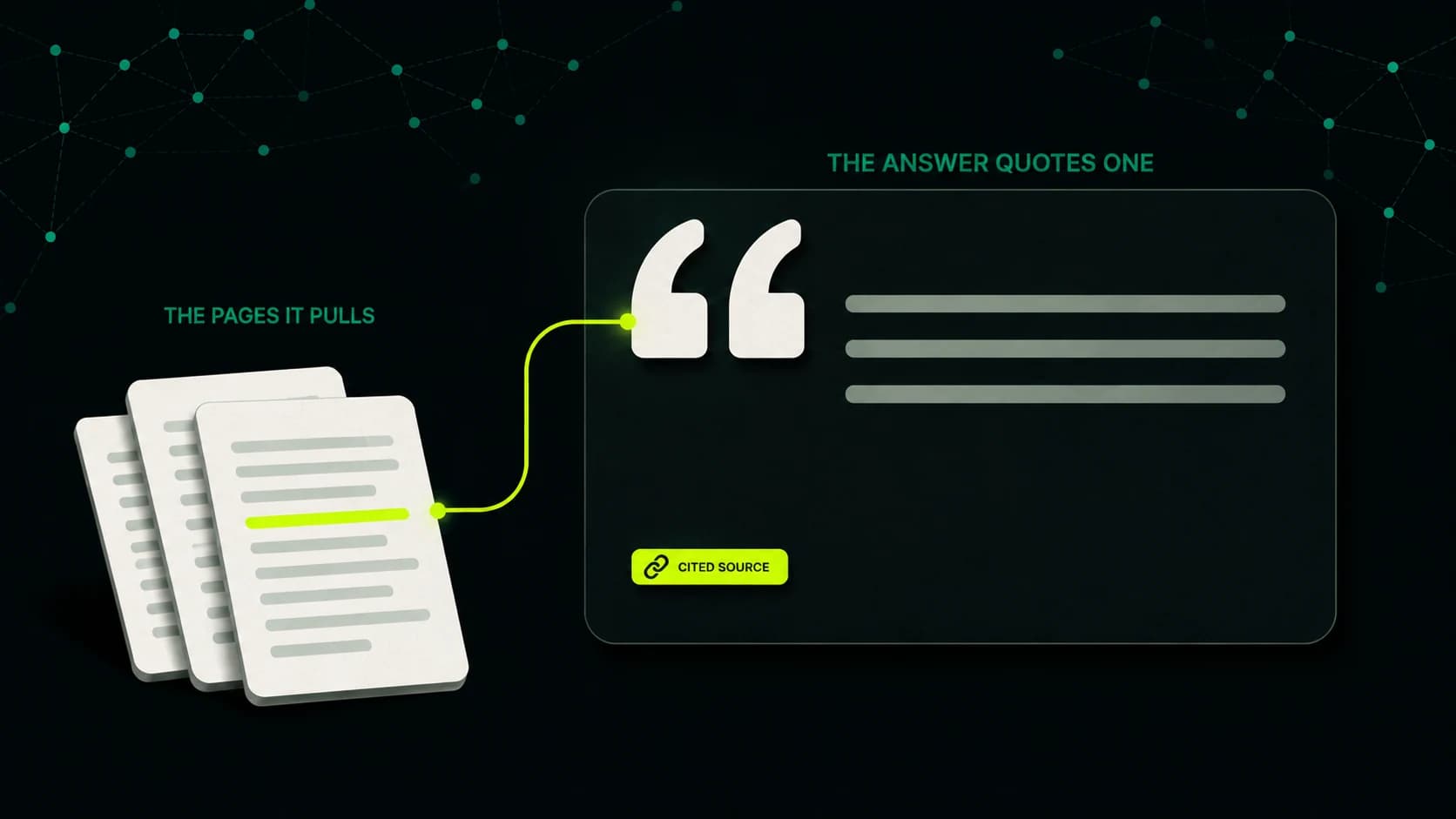
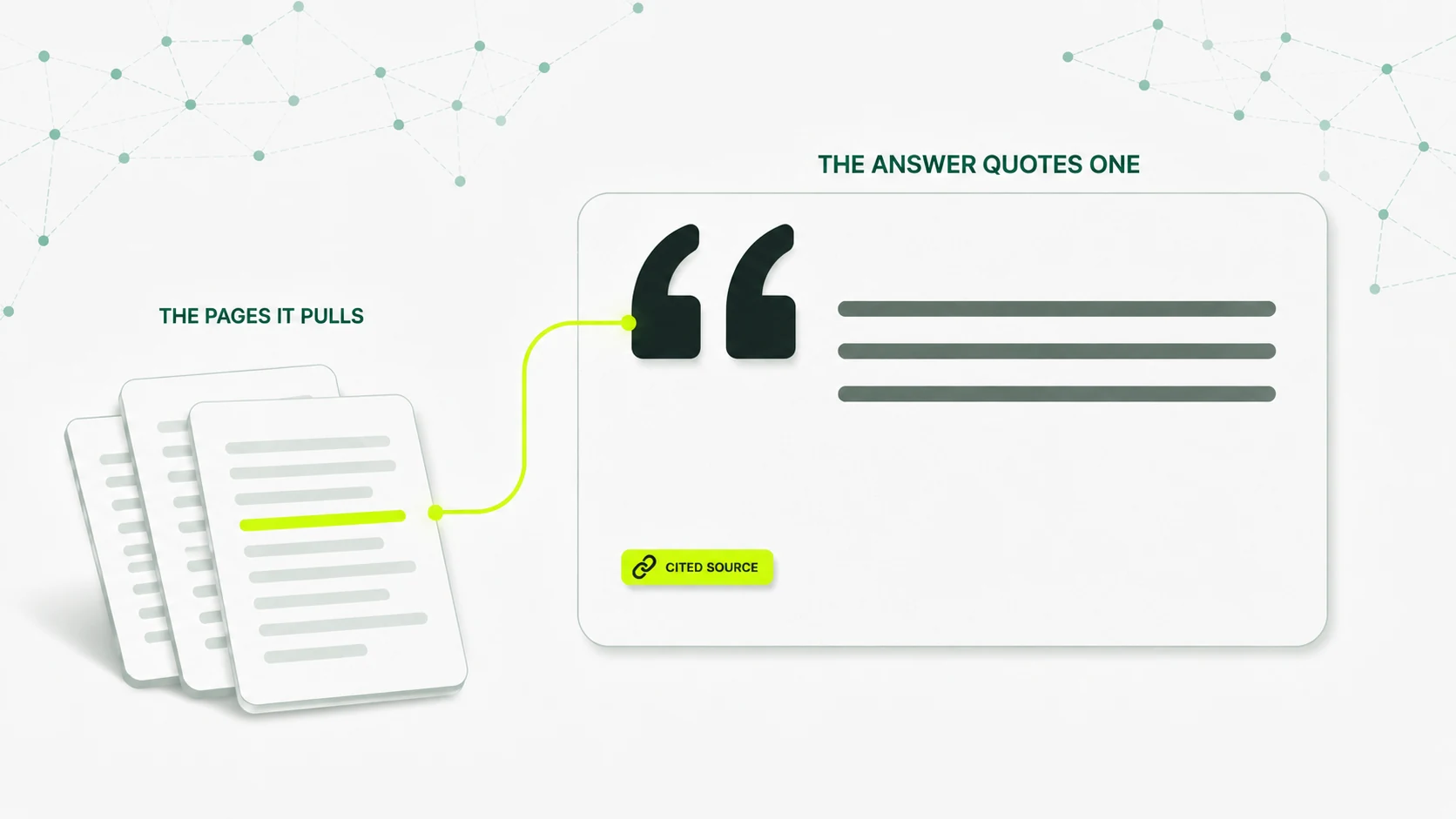
When a chatbot answers a live question, it rarely works from memory. It searches, pulls back a handful of web pages, and writes its reply from what those pages say. Google describes its own Artificial Intelligence features in plain terms. They use retrieval-augmented generation (RAG), which Google also calls grounding, relying on our core Search ranking systems to retrieve relevant, up-to-date web pages from our Search index1. If that sounds familiar, it should. It is the same open-book setup from the RAG brief2, pointed at the whole web instead of your own documents. The other assistants work the same way. Anthropic says a Claude web search response includes citations for sources drawn from search results3, and OpenAI's ChatGPT search links to the sources it used4 under each reply.
How does a page end up cited in the answer?
Index
the page is crawled and eligible to appear in search at all
Retrieve
the engine pulls it as one of a few pages that fit the question
Quote
a clear, self-contained claim is easy to lift into the reply
Cite
the answer links back to the page it leaned on
Fresh, well-sourced pages get pulled again on the next question; unindexed ones never enter.
What's Real?
- It runs on retrieval, so the floor is being retrievable. Before any tactic, the page has to be in the index. Google says a page is eligible for its AI features only if it is indexed and eligible to be shown in Google Search with a snippet1. No index entry, no citation. The reassuring part: there is nothing exotic to install. Google is blunt that you don't need to create new machine readable files, AI text files, markup, or Markdown1 to appear in its AI answers.
- Content-level choices measurably move the needle. The research that coined the term Generative Engine Optimization (GEO) tested nine tactics on real generative answers. Its top three were plain moves toward credibility: citing sources, adding quotations, and adding statistics. Together they lifted a page's visibility by up to 40%5 in the answer. The wins came from looking more like a source worth trusting.
- The old keyword tricks do not carry over. In the same study, keyword stuffing5 gave little to no improvement, and the authors warn that techniques effective in search engines may not translate to success5. No single move wins everywhere, either, since the effect varies across domains5. A finance answer and a recipe answer reward different things.
- A citation is not control, and not proof. The assistant rewrites your page into its own words, so a reader sees the model's summary, which can drift from the page or turn into a confident guess6 when the page is thin. Being named in an answer is also not the same as a click. Treat a citation as a mention you earned, then check how it reads.
The “so what” — for anyone serving tech clients
- Write the page to be quoted. Lead with the answer, then back it: cite primary sources, include the real numbers, and make each key claim clear enough to lift on its own. Those are the same moves the GEO research measured5, and they double as plain good writing. A brief that reads like a credible briefing is one an assistant can quote and a human can trust.
- Get the boring fundamentals right before any “AI SEO” upsell. A page has to be indexed and snippet-eligible1 to be cited at all, and Google says there is no special file or markup to add for its AI answers. When a vendor pitches a secret trick that unlocks the assistants, that is the loud version talking.
- Set expectations in plain numbers. Visibility in AI answers varies across domains5, so it swings by topic and query, and a citation is a paraphrase the model can still get wrong6. Promise a client steady sourcing and honest measurement, not a guaranteed seat in every answer.
Sources
- Google Search Central — Optimizing for generative AI features on Google Search
- Cortexa Ground Truth Nº 3 — “RAG is just giving AI an open book”
- Anthropic — Web search tool (Claude Docs)
- OpenAI — Introducing ChatGPT search
- Aggarwal et al. — GEO: Generative Engine Optimization (KDD 2024; preprint)
- Cortexa Ground Truth Nº 2 — “AI doesn’t lie — it guesses confidently”
Next Reads
- Explainer5 min read
Guardrails work in layers.
No single control makes an AI guaranteed brand-safe. The honest answer is layers: steer it, screen it, filter it, and keep a person on the last mile.
- Explainer5 min read
Read an AI benchmark like a test score.
A benchmark score says how a model did on one fixed test, under one set of choices. It doesn't say how it will do on your client's job.


