Cortexa Ground Truth
Nº 28 · Explainer · · 5 min read

Tip: once it’s playing, tap any line to jump the audio there.
To prove the AI paid off, measure the baseline.
A vendor’s 700% case study is marketing. Proving the ROI of your own AI work takes a baseline, honest attribution, and the full cost.
“So did the Artificial Intelligence (AI) pay off?” Every team that talks a client into an AI project gets the question eventually. The answer that holds up is a number you can defend: the work is faster, cheaper, or better by this much, measured against what came before, after you subtract what it cost to run. A vendor’s 700% case study doesn’t give you that.
Why is AI return so hard to prove?
The loud version of return on investment (ROI) is a slide with one enormous number on it. The measured version is quieter, and more useful. When Stanford’s AI Index looked at what companies report from AI, the gains were real and modest: firms that see savings mostly report cost savings of less than 10%1, and where revenue rises, the most common level of revenue increases is less than 5%1. A confident case study is easy to produce and easy to believe, the same way a fluent AI answer can be wrong2.
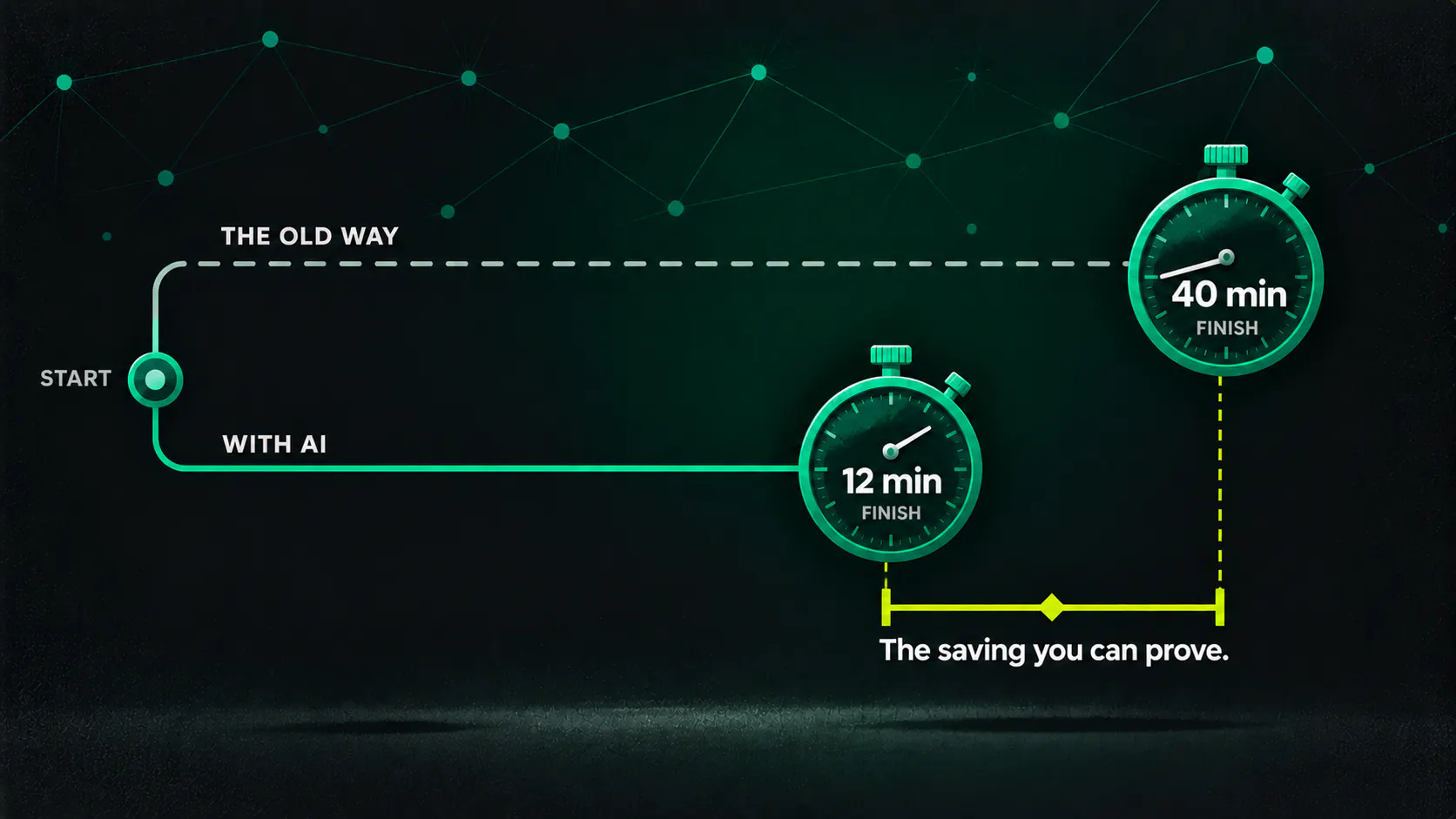
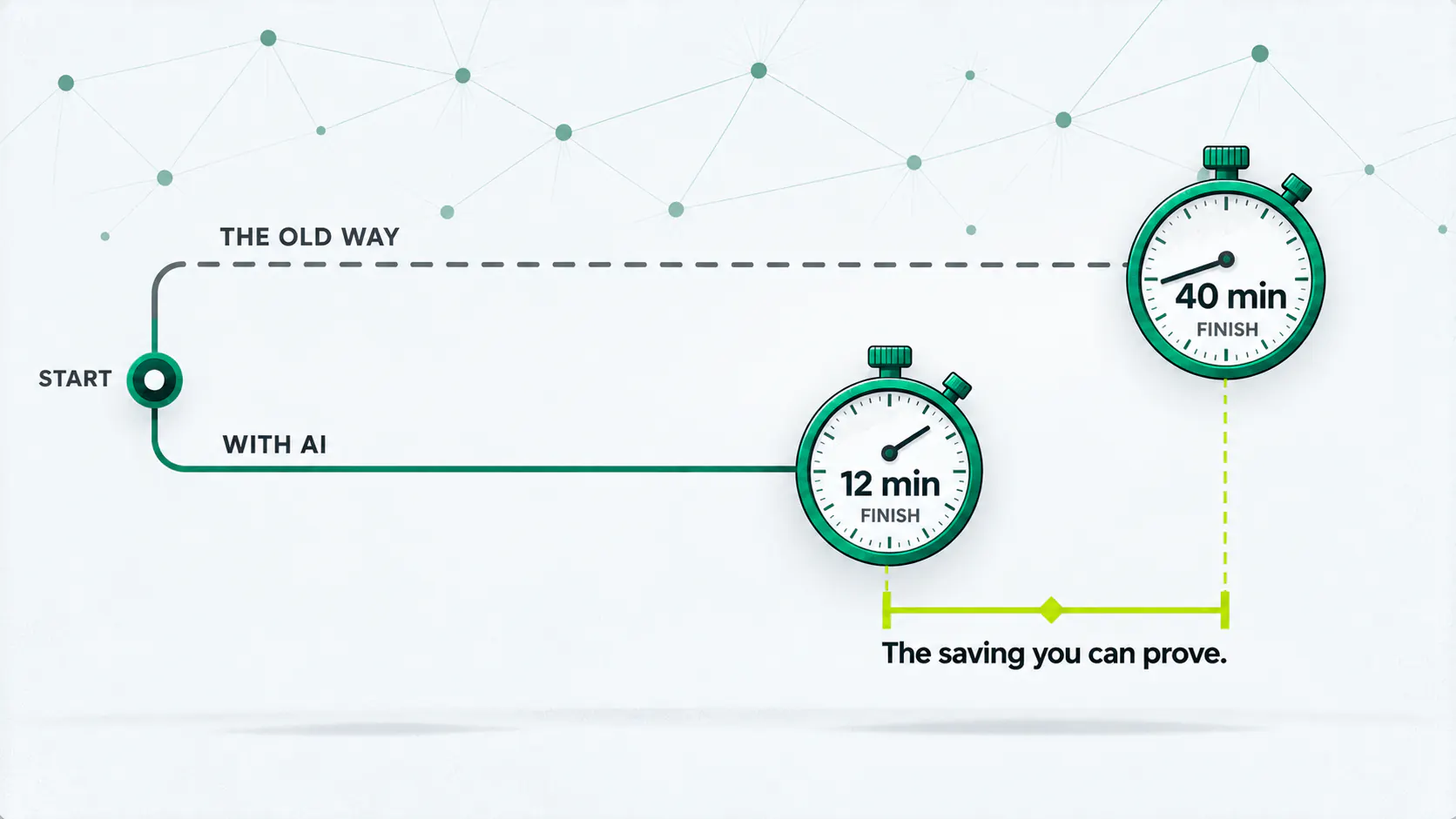
How do you measure it honestly?
Weigh the before
record what the work costs and how long it takes today, before the tool goes in
Isolate the cause
compare against a held-back group doing the work the old way
Count the full cost
the license plus integration, human review, and the reruns when it is wrong
Tie it to the business
move a metric the client already tracks
A gain you can’t trace to the AI, net of what it cost, is a gain you can’t promise.
What's Real?
- The gains are real, and usually smaller than the pitch. In Stanford’s AI Index, firms that report savings mostly report cost savings of less than 10%1, and where revenue rises, the most common level of revenue increases is less than 5%1.
- Controlled tests show where the lift is real. In a Boston Consulting Group field experiment, consultants using AI on well-suited tasks finished 12.2% more tasks on average, completed tasks 25.1% more quickly3, and produced 40% higher quality results3, measured against a group who worked without it.
- The same test shows where it backfires. On a problem built to sit outside the model’s competence, the consultants who leaned on AI did worse3 than those who did not, talked into a confident wrong answer. The tool helps on the right tasks and hurts on the wrong ones, and only measurement tells them apart.
- Proving it is a named discipline. The United States National Institute of Standards and Technology (NIST) tells teams to run quantitative, qualitative, or mixed-method4 measurement, and that AI systems should be tested before their deployment and regularly while in operation4. Proof is measurement done on purpose, and on a schedule.
The “so what” — for anyone serving tech clients
- Baseline on day zero, before you build. The most valuable move on an AI project costs nothing and happens at the start: write down what the task costs and how long it takes today. Skip it and all you can do is claim the lift.
- Price the whole thing. The subscription is the visible cost. Integration, the human review step, and the reruns when the model is wrong are the rest, the same gap the demo-to-production brief5 named between a slick demo and a shipped product.
- Prove it on their work. Whether the tool clears the bar on a client’s real cases is an evals6 question, and it is answered on their own examples.
- Sell the measurement as part of the job. Offer a metric the client already watches and a date to read it. That is the line between a partner and a vendor with a slide.
Sources
- Stanford HAI — 2025 AI Index Report, Economy
- Cortexa Ground Truth Nº 2 — “AI doesn’t lie — it guesses confidently”
- Ethan Mollick, One Useful Thing — “Centaurs and Cyborgs on the Jagged Frontier” (reporting the Dell’Acqua et al. BCG field experiment)
- NIST — AI Risk Management Framework (AI RMF 1.0), Core: the MEASURE function
- Cortexa Ground Truth Nº 7 — “A great demo isn’t a shipped product”
- Cortexa Ground Truth Nº 8 — “Evals, in plain English”
Next Reads
- Explainer
What “agentic AI” actually means
Agentic AI isn't smarter answers — it's software that takes actions toward a goal. Here's what's real, and why it still needs a human in the loop.
- Explainer
AI doesn’t lie — it guesses
Why Artificial Intelligence (AI) “hallucinates,” in plain English: it isn’t lying — it predicts likely words, and a confident guess can still be wrong.