Cortexa Ground Truth
Nº 2 · Explainer · · 5 min read

Tip: once it’s playing, tap any line to jump the audio there.
AI doesn’t lie — it guesses confidently.
Why Artificial Intelligence (AI) “hallucinates,” in plain English: it isn’t lying — it predicts likely words, and a confident guess can still be wrong.
“The AI lied about the data.” “The AI just made it up.” “The AI created those numbers or facts.” Every team serving tech clients hears some version of this, usually in a small panic. Here’s what they “should” be saying to more accurately describe the situation (without the drama): the model wasn’t lying, and nothing was broken. The model was doing exactly what it was built to do — and once you see that, the fix stops being magic and starts being process.
AI is autocomplete with a diploma
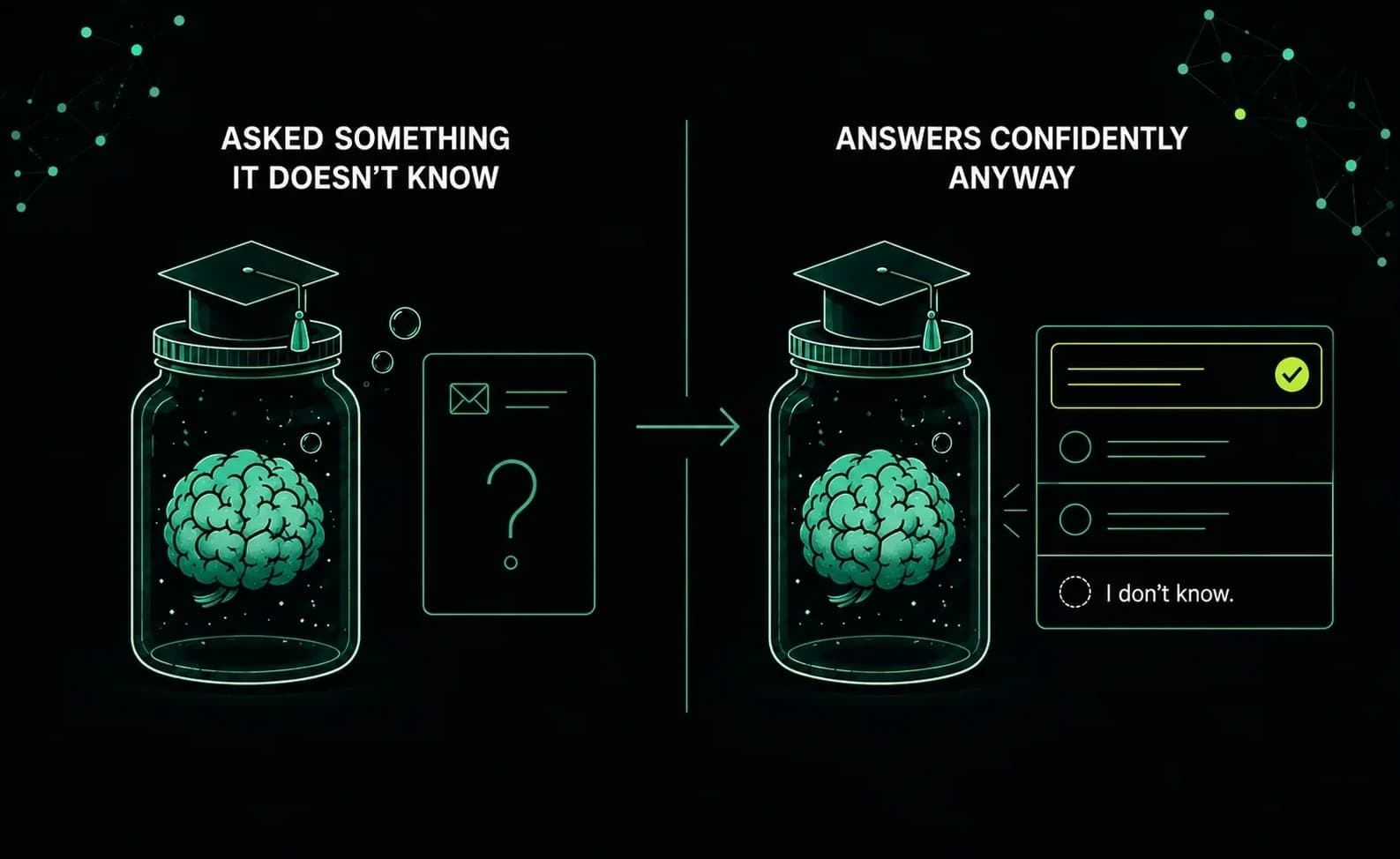
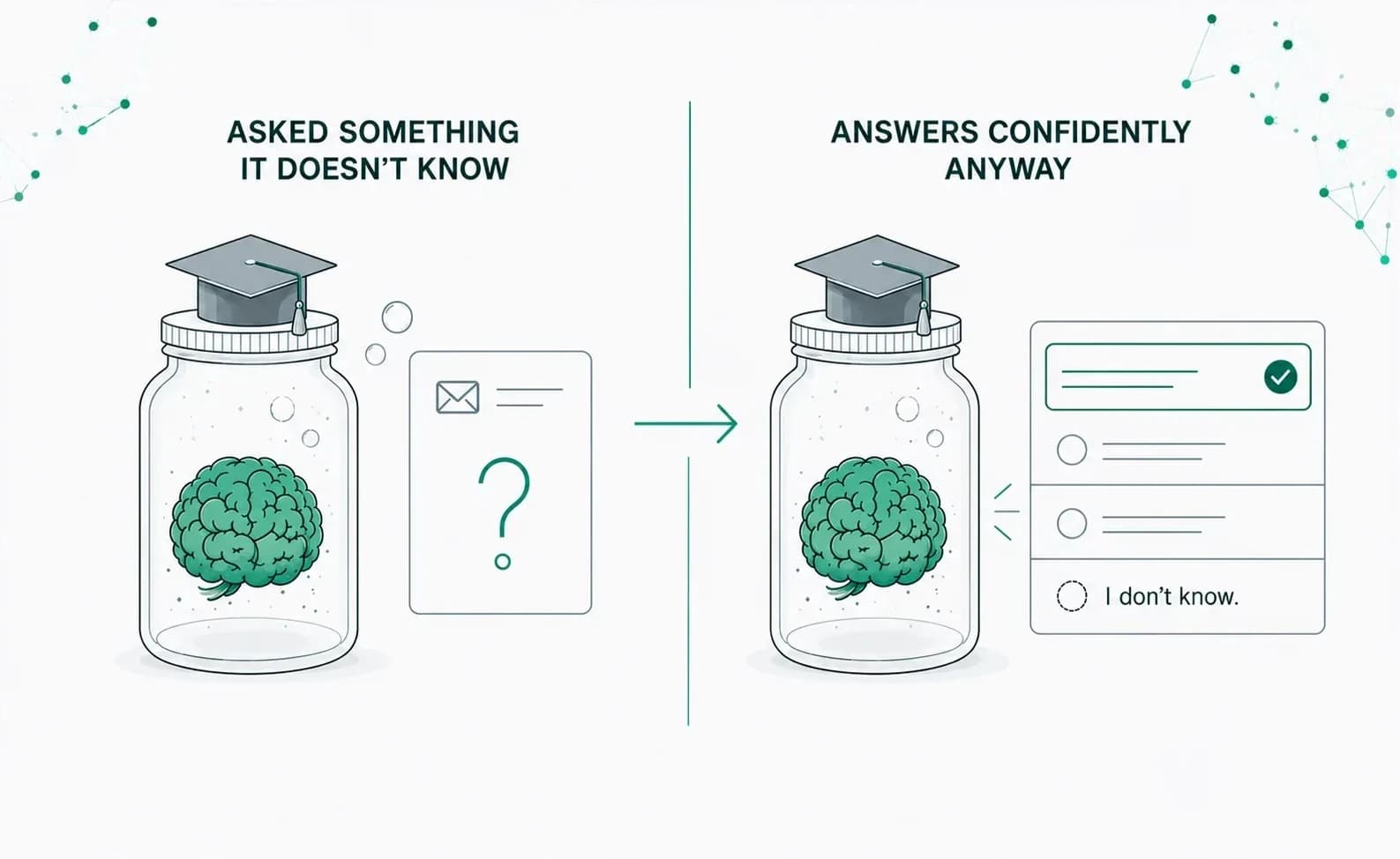
A Large Language Model (LLM) doesn’t “look something up” the way you’d check a file. It predicts the next most plausible word, then the next, from patterns in everything it read during training. Most of the time the most plausible words are also true (correct) — which is why it’s so useful. But when the model is unsure, it doesn’t stop. It doesn’t provide a confidence score. It doesn’t waver. It just keeps going. It produces the most likely-sounding continuation anyway: a fluent guess, delivered with the same confidence as a fact.
That’s the whole trick behind “a hallucination.” There’s no little voice inside the LLM’s neural network brain saying “I don’t actually know this.” The model is built to sound right — not to flag when it’s wrong.
Why this happens — in plain terms.
- The model is predicting, not remembering. The model reconstructs a plausible answer from patterns; it isn’t reading from a source of truth unless you give the model one — a point a major research review of hallucinations1 spells out.
- The model is rewarded for fluency. A confident, well-formed answer scores better than “I’m not sure,” so — like an eager intern — the model fills the gap rather than leaving it blank.
- The model has no built-in fact-check. Nothing verifies the claim before it reaches you. A confident tone tells you nothing about whether the claim is accurate.
How to reduce hallucinations
Ground the AI
give the AI real sources to cite
Allow “I don’t know”
let the AI abstain, not guess
Cite
make the AI show its work
Verify
a human checks what matters
Layer them together — grounding does the heaviest lifting.
The “so what” — for anyone serving tech clients
- When a client says “the AI got it wrong,” reframe it: the AI guessed plausibly because it wasn’t grounded. The fix is usually sources plus a review step — not “a cleverer prompt.”
- Never put an ungrounded model in front of facts that carry risk — pricing, legal, medical, client data — without grounding and a human check. That’s where confident guesses get expensive.
Sources
- Ji et al. — Survey of Hallucination in Natural Language Generation (ACM Computing Surveys)
- Lewis et al. — Retrieval-Augmented Generation for Knowledge-Intensive NLP TasksThe primary paper behind “Ground the AI” — retrieval-augmented generation, the biggest lever for reducing hallucinations.
- Anthropic — Reduce hallucinationsPractical guidance behind the “allow ‘I don’t know’” and “make the AI cite” levers.
- NIST — AI Risk Management FrameworkThe governance basis for the “keep a human in the loop” lever — human oversight as a control.
Next Reads
- Explainer
RAG is just giving AI an
RAG in simple terms: don't hope the AI remembers — hand it the right documents and let it answer from the source, open-book style.
- Explainer
Fine-tune, retrieve, or just
Most “train it on our data” asks don't need training. A simple ladder — prompt, then ground (RAG), then fine-tune — tells you which one you actually need.