Cortexa Ground Truth
Nº 7 · Explainer · · 5 min read

Tip: once it’s playing, tap any line to jump the audio there.
A great demo isn't a shipped product.
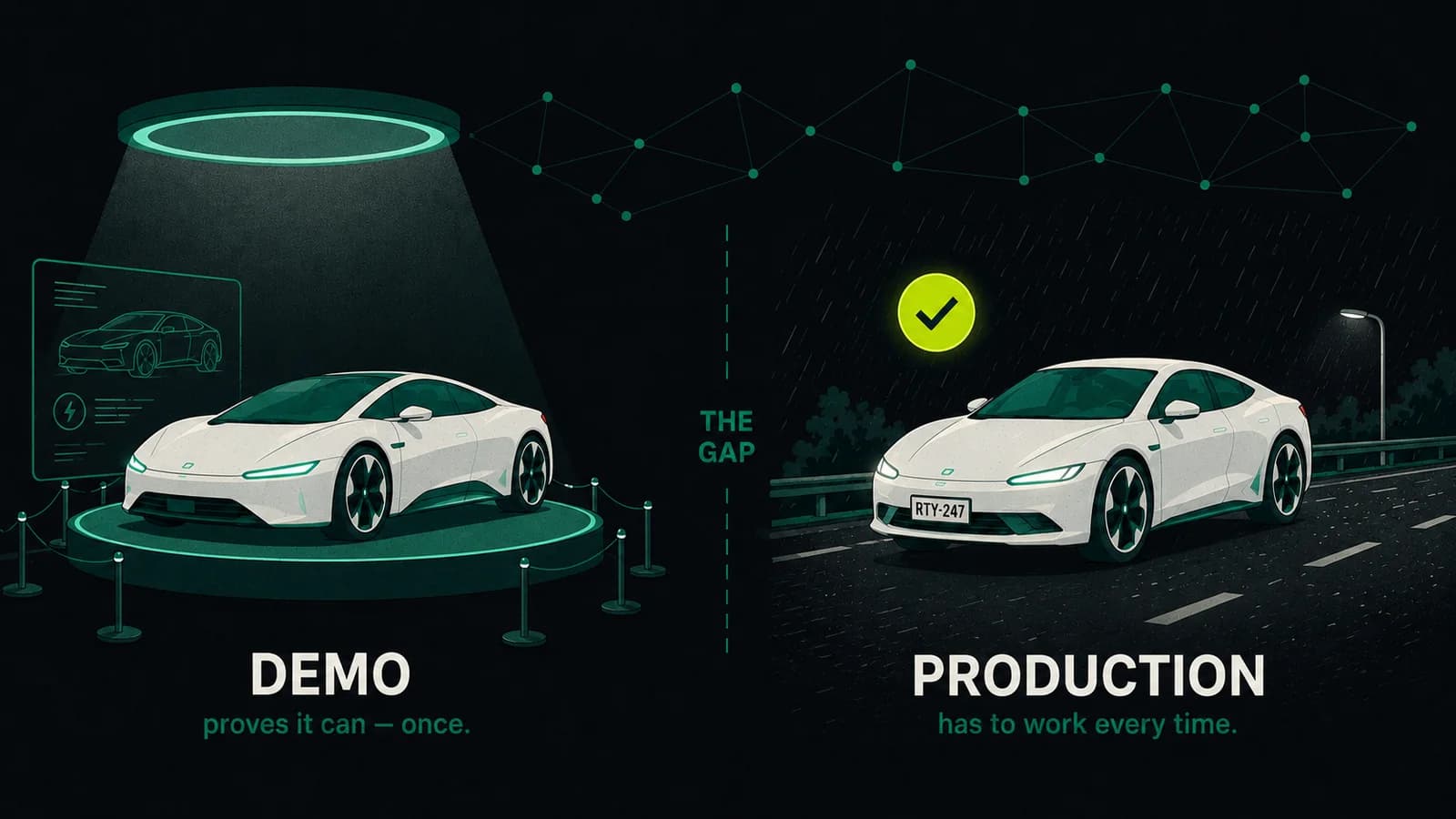
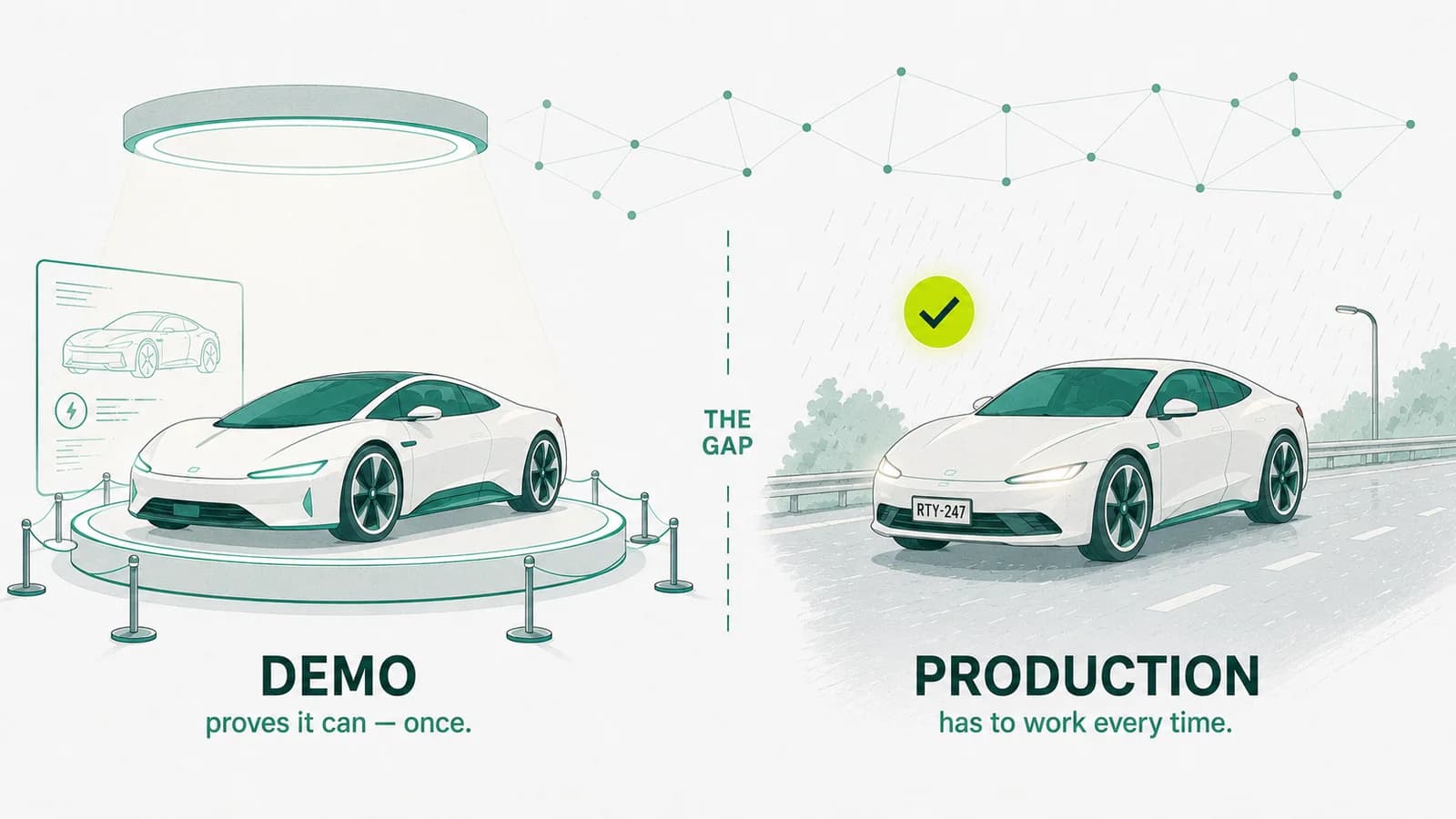
A demo proves Artificial Intelligence (AI) can work once. Production means it works every time — safely, at scale. That gap is where most projects stall.
“We saw it work.” It's the sentence that greenlights an AI project — and, quietly, the one that sets it up to stall. A demo proves the tool can do the thing, once, on a good day, with an example someone chose. Production means it does the thing every time, for messy real inputs, without a person standing by to catch it. The distance between those two is where most AI projects get stuck.
Why does the demo always look ready?
Because a demo is built to look ready. You pick the example, run it a few times, and keep the good one. That isn't dishonest — it's just what a demo is. But it quietly skips the part that actually costs time and money: the messy inputs, the edge cases, the ten-thousandth run, and what happens when the answer is wrong. A demo is a concept car on a turntable. Production is the car that has to start every morning — in the rain.
So what actually closes the gap?
Not a bigger model or a cleverer prompt. It's the same unglamorous engineering that turns any prototype into a product: measure it, ground it, put limits around it, and keep a person on the calls that matter.
Evals
measure it, don't eyeball it
Ground it
answer from real sources
Guardrails
limits for the bad cases
Human in the loop
a person checks what matters
A demo proves it can work once — these make it work every time.
What's actually real?
- You can't ship what you can't measure. The model-builders' own guidance is blunt: a successful application starts with clearly defining your success criteria, then designing evaluations to measure against them1. “It looked right in the demo” isn't a metric — a score against real examples is.
- Start simple; add machinery only when it earns its place. Anthropic's engineering guidance is to add complexity only when it demonstrably improves outcomes2, and to strip away abstractions as you move to production. A lot of demos break precisely because they piled on complexity the task never needed.
- Two levers do most of the reliability work. Grounding the model in real source material — the open-book approach behind Retrieval-Augmented Generation (RAG) — attacks wrong answers at the root3, and guardrails like input/output validation and defenses against prompt injection are the controls OWASP's security guidance for Large Language Model (LLM) apps4 says to build before you expose one to the public.
- For anything with real stakes, a person stays in the loop by design. Governance guidance like NIST's AI Risk Management Framework5 treats human oversight as a control to build in — not a courtesy to add later.
The “so what” — for anyone serving tech clients
- When a client greenlights a build off a demo, reset the expectation kindly: the demo proved it's feasible, not that it's ready. Scope the real work — evals, grounding, guardrails, and review — as the project, because that's where the timeline and the value actually live.
- Position your team on the last mile, not the first. Anyone can conjure a demo now; the rare, billable skill is making it reliable, safe, and measurable enough to put a client's name on. That's the part the AI can't do for itself.
Sources
- Anthropic — Create strong empirical evaluations (define success criteria & build tests)
- Anthropic — Building effective agents
- Lewis et al. — Retrieval-Augmented Generation for Knowledge-Intensive NLP Tasks (arXiv, preprint)
- OWASP — Top 10 for Large Language Model Applications
- NIST — AI Risk Management Framework
Next Reads
- Explainer5 min read
Evals, in plain English.
An eval is the test you run before an Artificial Intelligence (AI) feature ships — and every time after. It's how good gets measured, not eyeballed.
- Explainer5 min read
What “multimodal” really means for a campaign.
Multimodal AI works in more than text — it sees images and hears audio. Here's where that genuinely helps a campaign, and where it's still a party trick.


