Cortexa Ground Truth
Nº 39 · Explainer · · 5 min read
 By Joe Coffman, Founder of Cortexa Consulting
Tip: once it’s playing, tap any line to jump the audio there.
Is it an agent? Ask who decides the next step.
An AI agent is software where the model picks its own next step. If a person or a fixed script picks it, you're buying a chatbot, copilot or workflow.
“Our platform is a fully autonomous AI agent.” Most agency teams now hear a version of that line in vendor decks, and the word gets attached to products that behave very differently. You don't need a technical background to sort them out. You need one question: who decides the next step?
What do chatbot, copilot, workflow and agent each mean?
Each word answers that question differently. A chatbot answers when you ask, and you choose what to ask next. OpenAI's guide to building agents says applications that use a Large Language Model (LLM) without letting it control the work, think simple chatbots, single-turn LLMs, or sentiment classifiers2, are not agents. A copilot sits beside you. Microsoft describes its own Copilot as your personal, private assistant that works solely for you3, and you still steer.
A workflow is the middle case. Anthropic defines workflows as systems where LLMs and tools are orchestrated through predefined code paths1. Someone wrote the route in advance, and the model fills in steps along it. An agent is different. Anthropic's wording is that LLMs dynamically direct their own processes and tool usage, maintaining control over how they accomplish tasks1. OpenAI's is shorter: agents are systems that independently accomplish tasks on your behalf2.
Picture a fairground. On the kiddie ride, a small car runs on a track. A child can turn its steering wheel all the way round, and the car still goes where the track goes. In the bumper cars the wheel really steers, which is why the rink has a padded wall and an attendant standing by a stop button. A lot of what gets sold as an agent is the kiddie ride: a track, and a wheel that isn't connected to it.
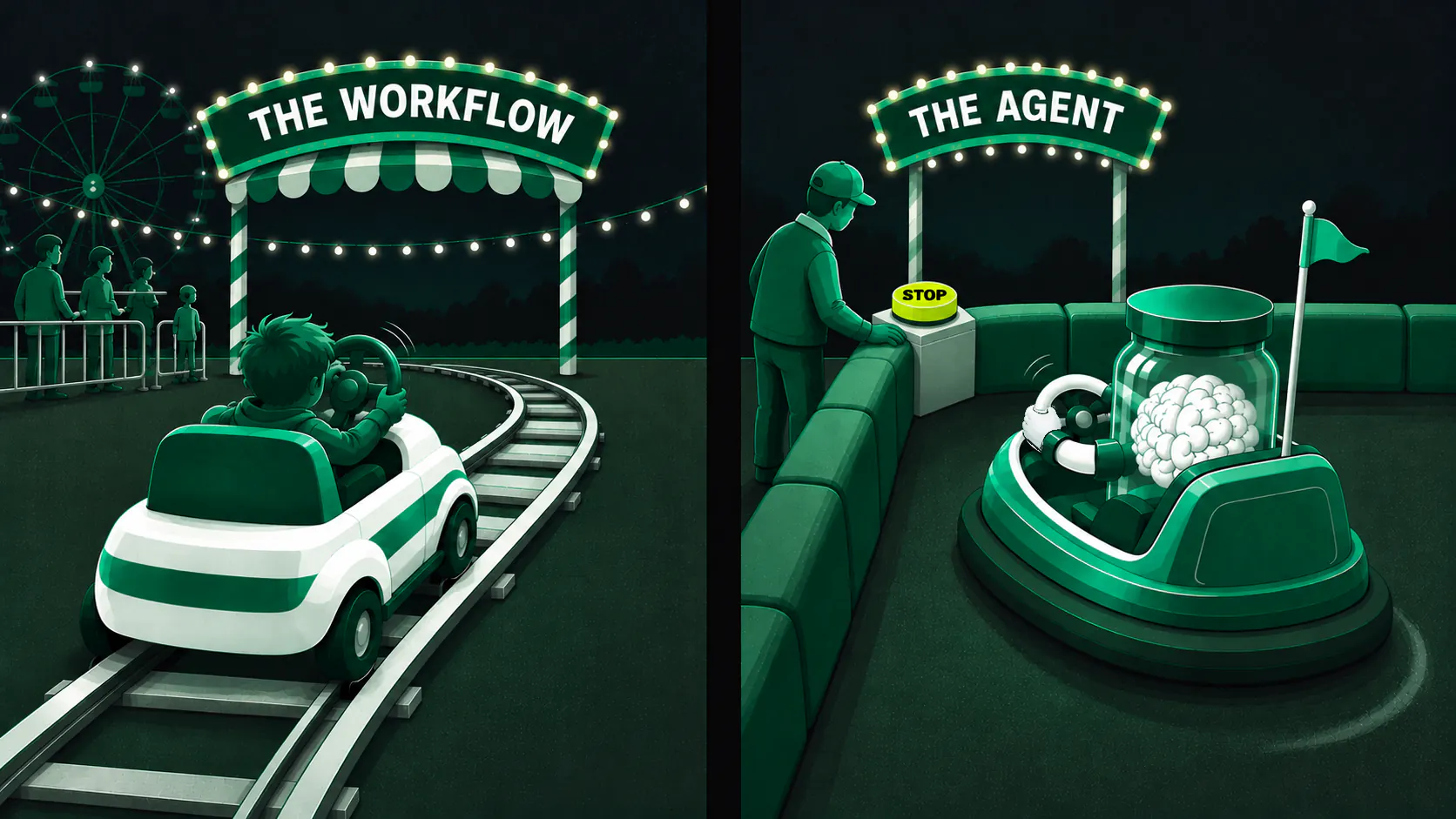
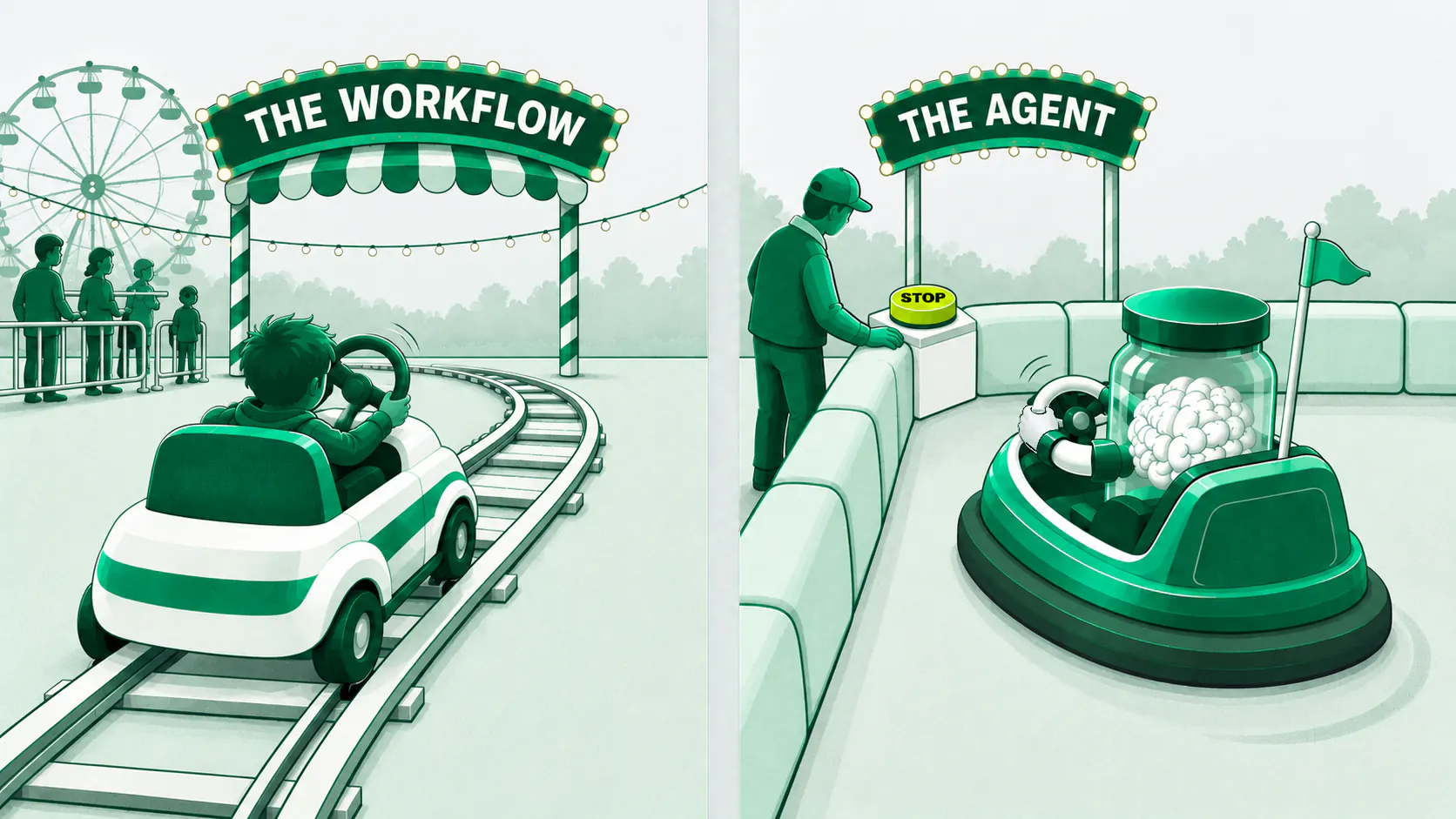
How do you tell which one you're being sold?
Three questions in the pitch meeting do most of the work. Who picks the next step, the person, a script, or the model? Can it do things in other systems, such as send, book, edit or buy, or does it only write text back? And what happens when it gets stuck? OpenAI's guide says a real agent recognizes when a workflow is complete2 and, on failure, can halt execution and transfer control back to the user2. If the answers are vague, the product is probably not what the label says.
01
Who picks the next step?
a person, a fixed script, or the model
02
Can it act in other systems?
send, book, edit or buy, or only write text back
03
What happens when it's stuck?
it stops and hands back, or it keeps going
04
Where does a person step in?
a checkpoint with a named owner
A model that picks the steps and can act is an agent. Then the last two questions carry the risk.
What's Real?
- The labs agree on the core. Anthropic and OpenAI word it differently, but both put the model in charge of the steps. Anthropic draws an important architectural distinction between workflows and agents1, and the line sits at who controls the path. A vendor who can't say who controls it hasn't told you what they sell.
- Autonomy comes with brakes, by design. Anthropic notes that agents can then pause for human feedback at checkpoints or when encountering blockers1, and recommends stopping conditions (such as a maximum number of iterations)1. An agent with no stop and no handoff is a design gap.
- Some agents run with nobody watching. Microsoft says its agents can be configured to react to events or triggers without human input3, and its own example has an agent compiling cases for skilled human review3. Whether a person looks before the action lands is a setting someone chose.
- Simpler is often enough. Anthropic recommends finding the simplest solution possible, and only increasing complexity when needed1, and notes that agentic systems often trade latency and cost for better task performance1. A well-built workflow is a good product. Calling it an agent adds a price and no capability.
The “so what” — for anyone serving tech clients
- Take the three questions to the next vendor meeting and write down the answers. It takes ten minutes, and it replaces a label with a description you can repeat to the client.
- Match the label to the risk. A copilot that drafts text for a person to approve needs little oversight. An agent that acts inside a client's systems needs a named owner, a stop, and a record of what it did. Our brief on prompt injection4 covers what can go wrong when it reads something hostile.
- Start with the simplest thing that does the job. If a workflow solves the client's problem, recommend the workflow. For what an agent is and what it takes to ship one, see our earlier pieces on agentic AI5 and on agents that ship6.
Sources
- Anthropic — “Building effective agents”
- OpenAI — “A practical guide to building agents” (PDF)
- Microsoft — “Unlocking autonomous agent capabilities with Microsoft Copilot Studio”
- Cortexa Ground Truth Nº 29 — “Can someone hijack the AI feature we built for a client?”
- Cortexa Ground Truth Nº 1 — “What ‘agentic AI’ actually means”
- Cortexa Ground Truth Nº 11 — “Which AI agents actually ship?”
Up next · 1 of 2 in AI agents


More in Ground Truth
- Explainer5 min read
What “agentic AI” actually means plainly.
Agentic AI isn't smarter answers — it's software that takes actions toward a goal. Here's what's real, and why it still needs a human in the loop.
- Explainer5 min read
AI doesn’t lie — it guesses confidently.
Why Artificial Intelligence (AI) “hallucinates,” in plain English: it isn’t lying — it predicts likely words, and a confident guess can still be wrong.


