Cortexa Ground Truth
Nº 11 · Explainer · · 5 min read

Tip: once it’s playing, tap any line to jump the audio there.
Which AI agents actually ship?
Plenty of AI agents dazzle in a demo; far fewer survive real work. Here's how to tell a production-ready agent from a supervised experiment.
Every Artificial Intelligence (AI) “agent” pitch ends the same way: the agent runs the whole job, hands-free, while everyone watches. Here's the part that never makes the pitch: most of the agents quietly doing real work today aren't full agents at all — they're workflows on rails with a couple of smart steps. Now that everyone knows, and we can all agree, what an “agent” actually is1 — a Large Language Model (LLM) given hands, tools, and a goal — the sharper question is the one clients ask next: not “what is an agent?” but “which ones can we actually ship?” The honest answer: the narrow, checkable, supervised ones. Here's how to tell them apart before a client's name and your reputation is put on the line.
Why does every agent look ready in the demo?
Because a demo is the agent's best day, staged — the same pattern we unpacked in a great demo isn't a shipped product2, and all of it applies here. What agents add is stakes: an agent doesn't only answer — it acts. A wrong answer in a chat is a bad paragraph; a wrong action is a sent email, a changed record, a spent budget — taken confidently, with no one watching. The demo can't show you that, because the demo is precisely the run where someone was watching.
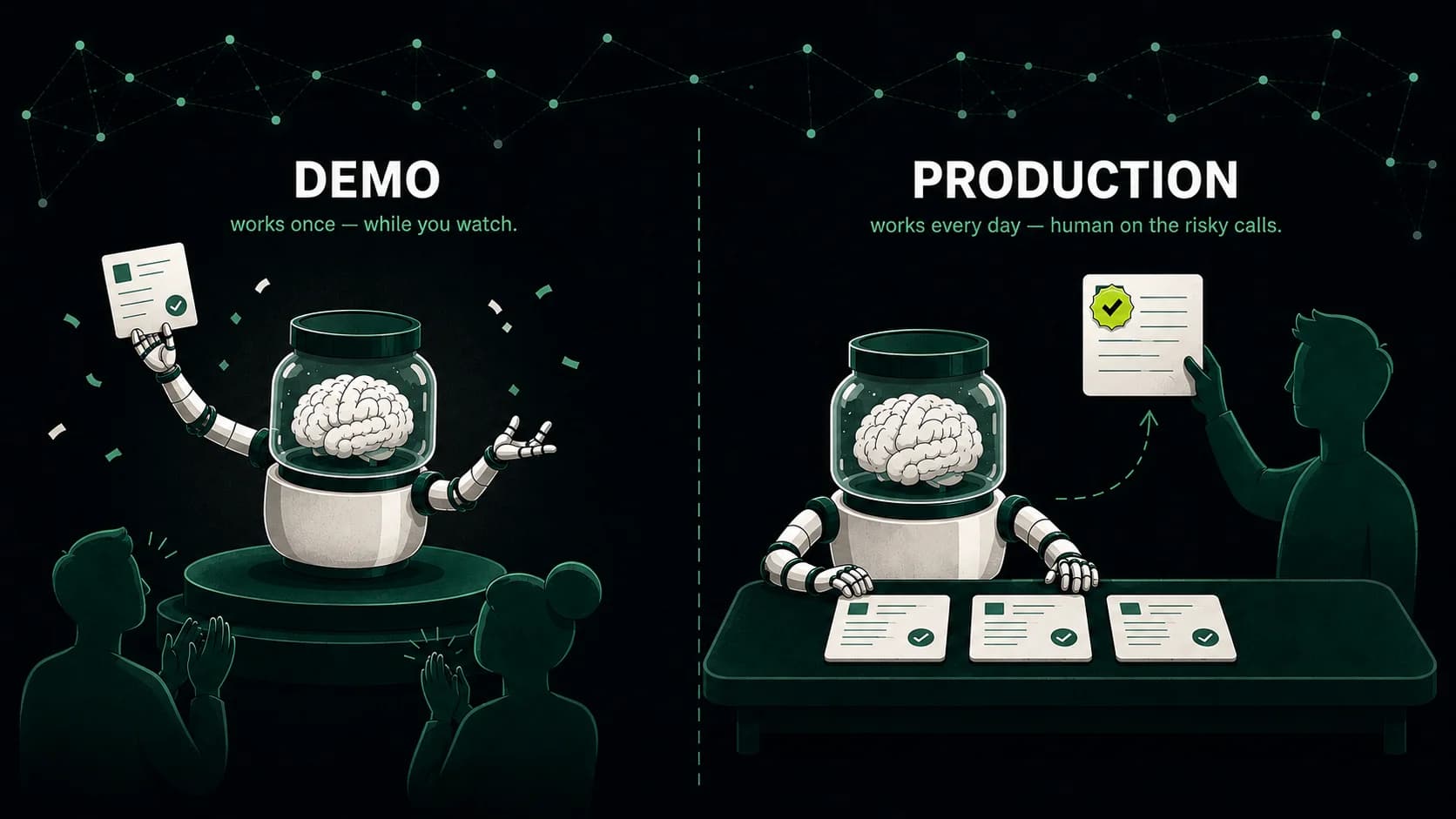
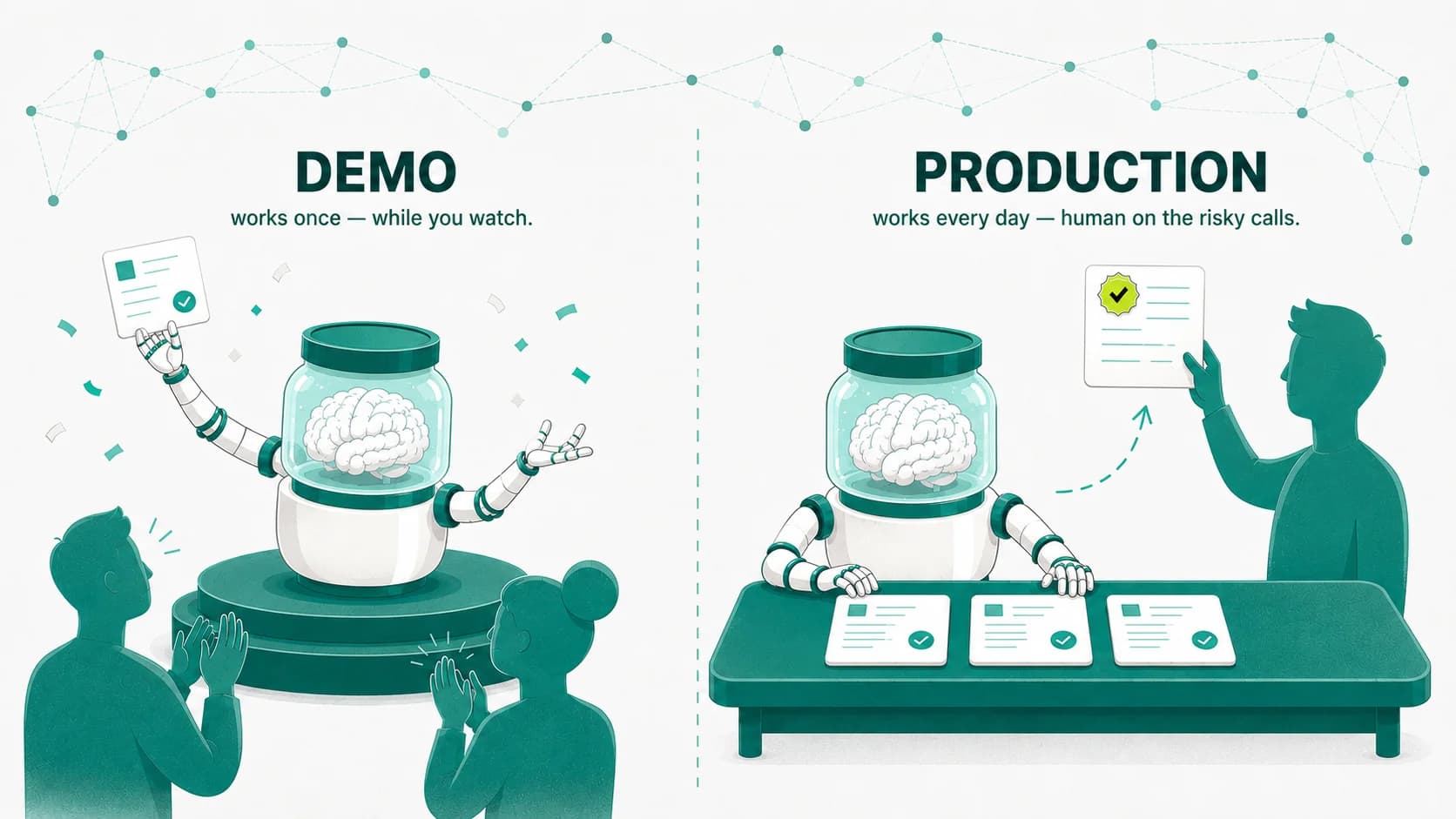
Workflow or agent? Most that ship are workflows
Here's the distinction that saves projects. Workflows are systems where LLMs and tools are orchestrated through predefined code paths3; true agents let the model direct its own process and tool use. The demo sells the second. What quietly ships is usually the first — a mostly-fixed path with one or two smart steps — and that isn't a downgrade, it's the point. Reserve full autonomy for open-ended problems where it's difficult or impossible to predict the required number of steps3. If you can hardcode the path, hardcode it — it's cheaper, steadier, and far likelier to survive real inputs.
So which agents actually ship today?
The ones doing a narrow, checkable job — not “run the account.” Anthropic's engineering guidance notes agents are emerging in production3 as models get better at using tools and recovering from errors — and its clearest example is telling. A coding agent works because the problem is well-defined and structured3 and the output is verifiable through automated tests3. Bounded and checkable is the whole game.
Bounded
a narrow job, not “run the account”
Checkable
each run is easy to verify
Reversible
a wrong step is cheap to undo
Scoped tools
least-privilege, real sources
Human on risk
owns the high-impact calls
Clears all five? Ship it — with a human watching. Misses one? It's still a supervised experiment.
What holds up in production?
- The patterns that ship are simple, not autonomous. The prevailing engineering guidance is to find the simplest solution possible3 and add complexity only when it demonstrably improves outcomes3. A lot of “agent” demos break precisely because they piled on autonomy the task never needed.
- Autonomy has a bill the demo hides. Anthropic is blunt that the autonomous nature of agents means higher costs, and the potential for compounding errors3, because the model runs for many turns with no one checking in between. That's why the shippable version keeps a hand on the controls — pausing for human feedback at checkpoints3 and setting stopping conditions (such as a maximum number of iterations)3. An agent you can trust is one you can interrupt.
- The failure mode isn't a dumb agent — it's an over-empowered one. OWASP's “Excessive Agency” risk for LLM apps5 is what happens when an agent can take high-impact actions on its own, and the fix is blunt: scope the tools to the minimum and require a human to approve high-impact actions before they are taken5.
- For anything with real stakes, oversight is a required control mechanism, not a courtesy. Governance like NIST's AI Risk Management Framework6 treats human oversight as something you build in — and the canonical primers describe the same modest plan → act → review4 loop, not a hands-off oracle.
The “so what” — for anyone serving tech clients
- When a client says “build us an agent that runs X,” run the field test with them in the room. You'll almost always find one bounded, checkable slice that ships now — and a larger “run the whole thing” ambition that stays a supervised experiment until the pieces are proven. Most of these ship as a workflow with a couple of smart steps and a human on the result; scoping that line honestly is the quote that survives contact with reality.
- Price the leash, not the magic — the same last mile where the demo-to-production gap2 lives. The demo was never the hard part. What a client is actually buying is the harness around the agent: the evals7 that prove each run, the guardrails around the high-impact steps, and the human on the calls that carry risk. That oversight is exactly what the agent can't do for itself — and it's what makes you the partner who ships viable products.
Sources
- Cortexa Ground Truth Nº 1 — “What ‘agentic AI’ actually means”
- Cortexa Ground Truth Nº 7 — “A great demo isn't a shipped product”
- Anthropic — Building effective agents
- Lilian Weng — LLM-powered autonomous agents
- OWASP — LLM06:2025 Excessive Agency (Top 10 for LLM Applications)
- NIST — AI Risk Management Framework
- Cortexa Ground Truth Nº 8 — “Evals, in plain English”
Next Reads
- Explainer
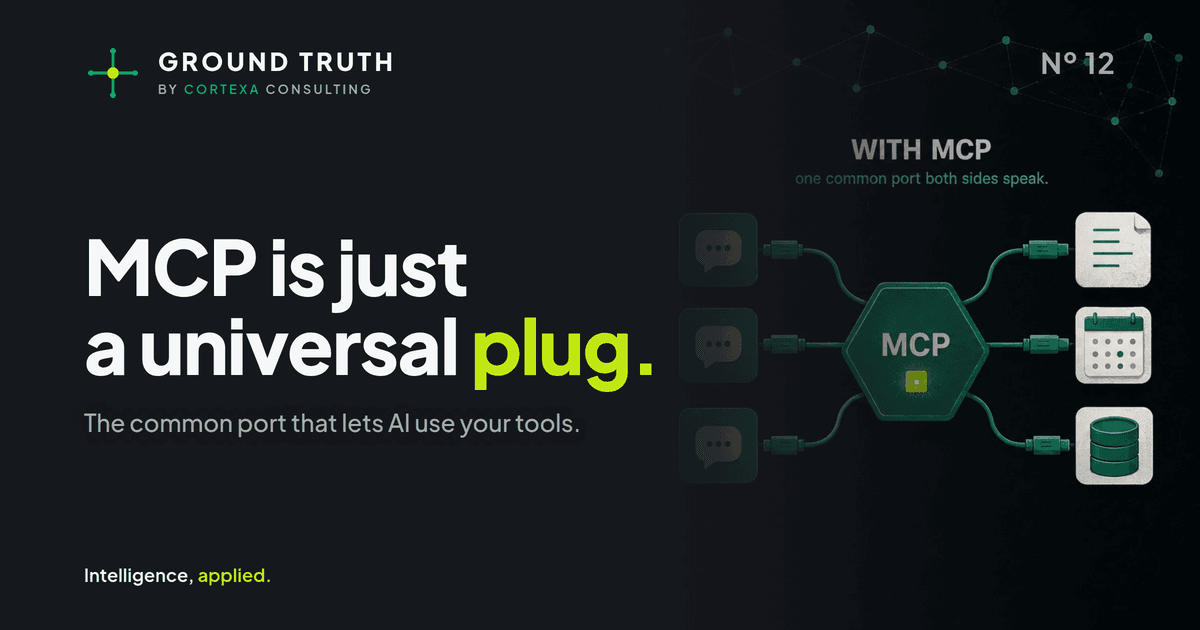
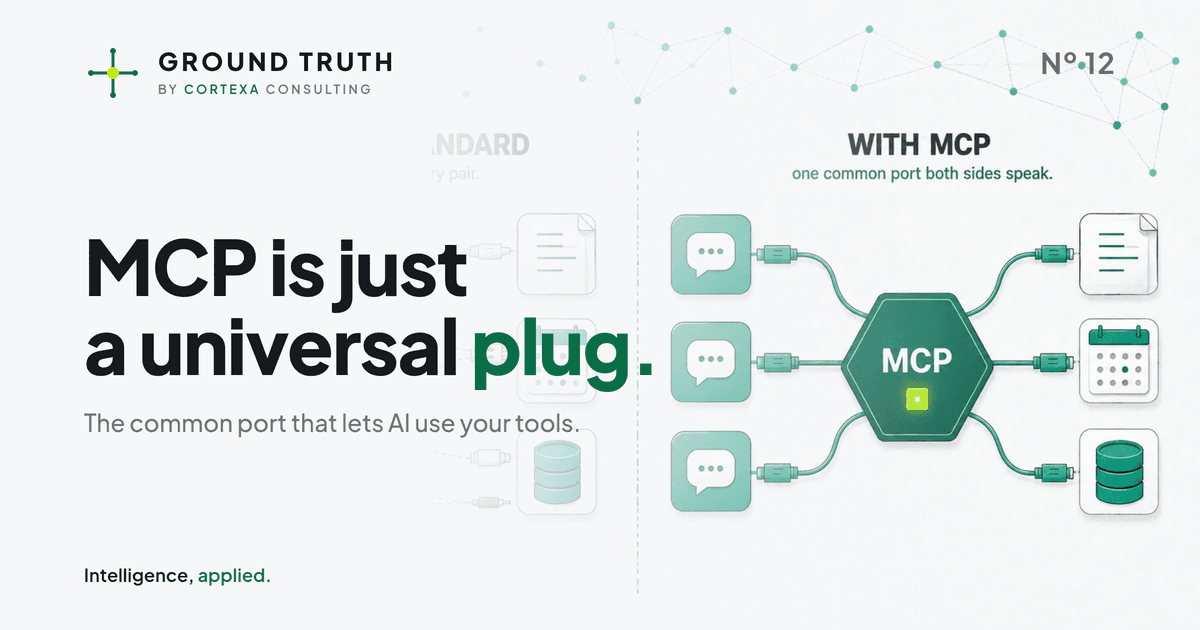
MCP is just a universal
“Can the AI use our tools?” The Model Context Protocol (MCP) is the common plug that lets it — one standard port, not a custom wire for every app.
- Explainer
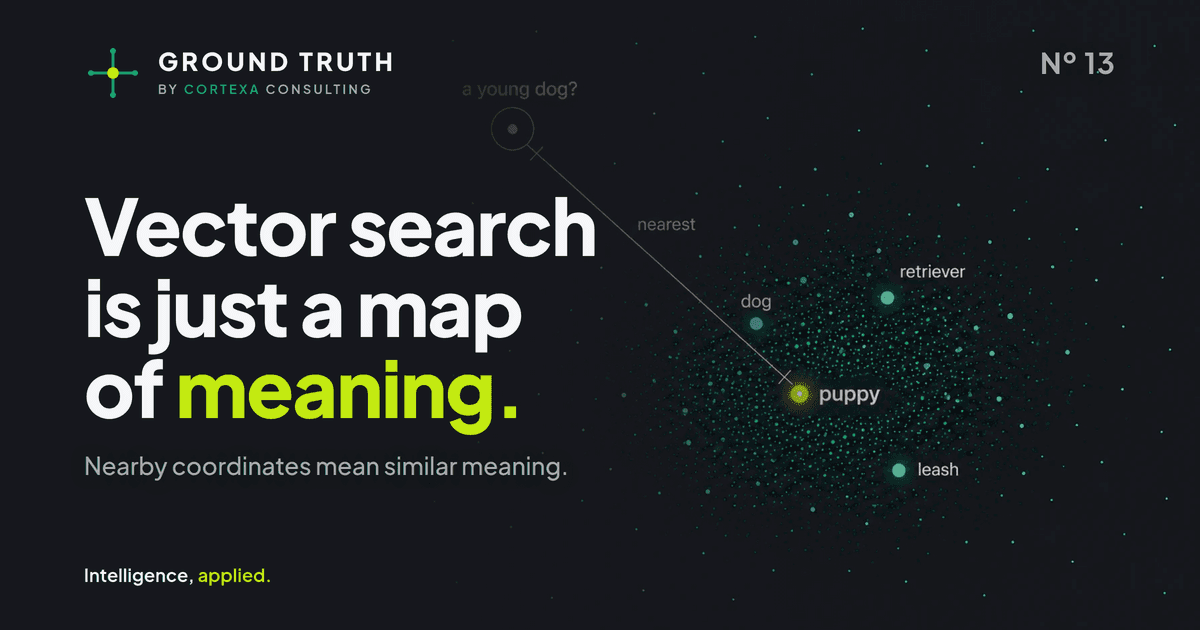
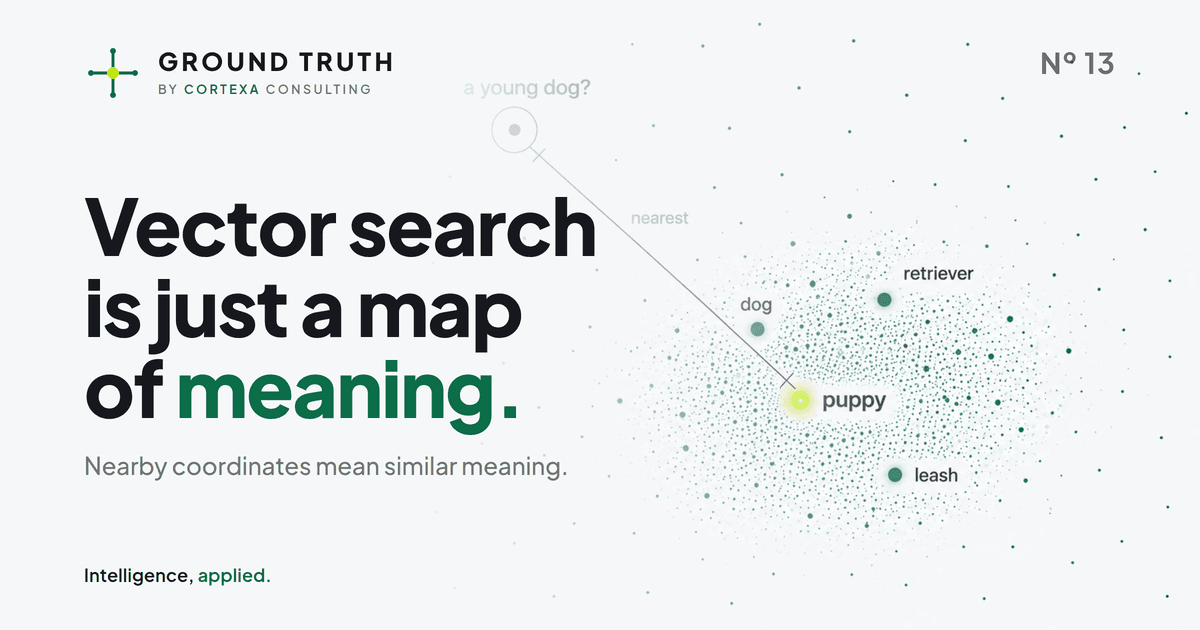
Vector search is just a map of
“Nearby means similar.” Embeddings turn text into coordinates, and a vector database finds the closest ones — the quiet engine behind RAG's open book.