Cortexa Ground Truth
Nº 27 · Explainer · · 5 min read

Tip: once it’s playing, tap any line to jump the audio there.
An AI version of a real person still needs consent.
Cloning a face or a voice is easy now. Using one in an ad needs the person's signed consent, and in California and New York that is the law.
“Can we just make an AI version of him for the spot?” The tools will do it before lunch. Feed them a few minutes of footage and a few minutes of audio, and you have a face that moves and a voice that lands. The question the software never asks is whether you are allowed to run it. In California and New York, Artificial Intelligence (AI) replicas of real people are now governed by statute, and the answer turns on one thing: what the person signed.
What did California and New York change?
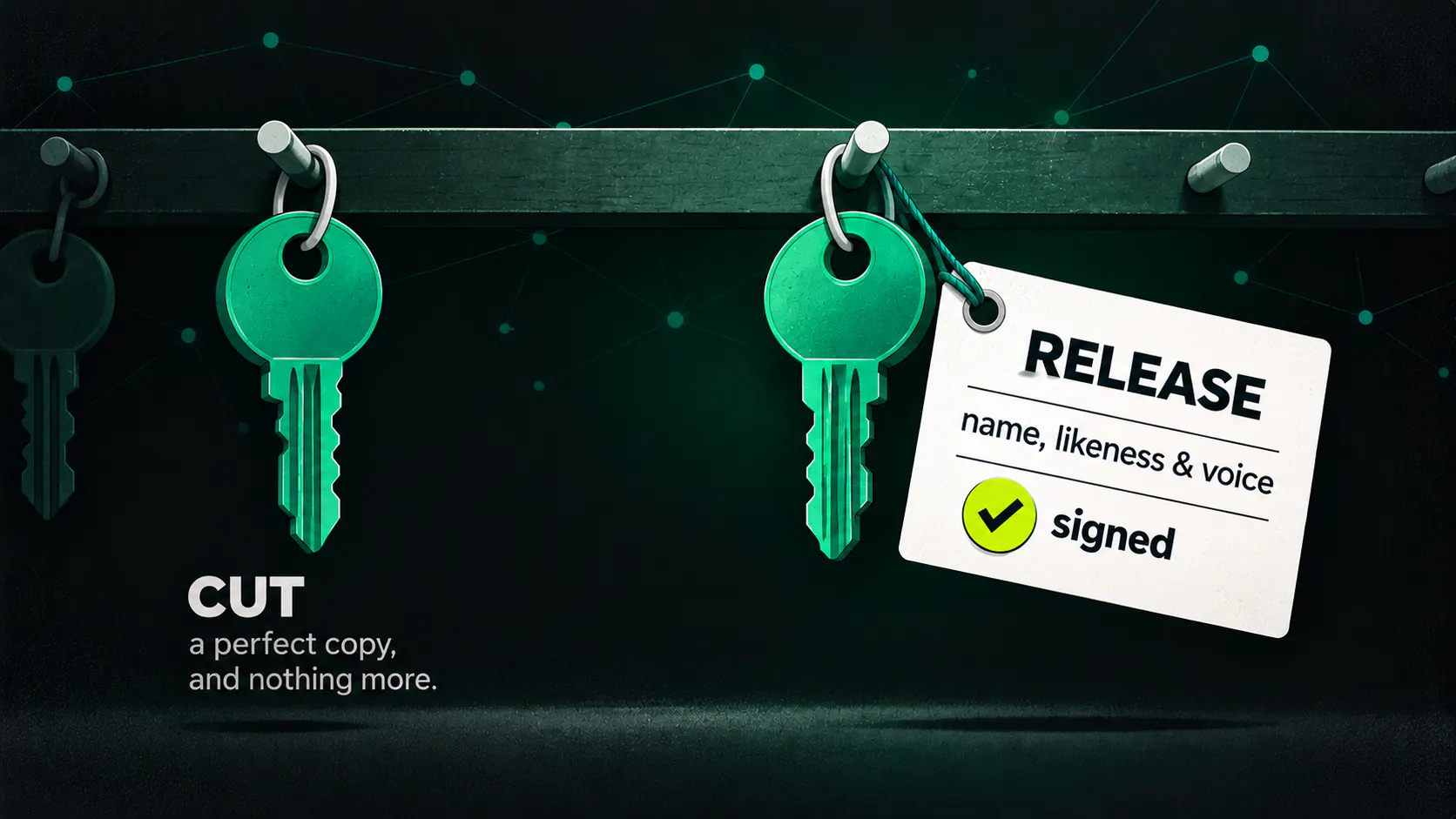
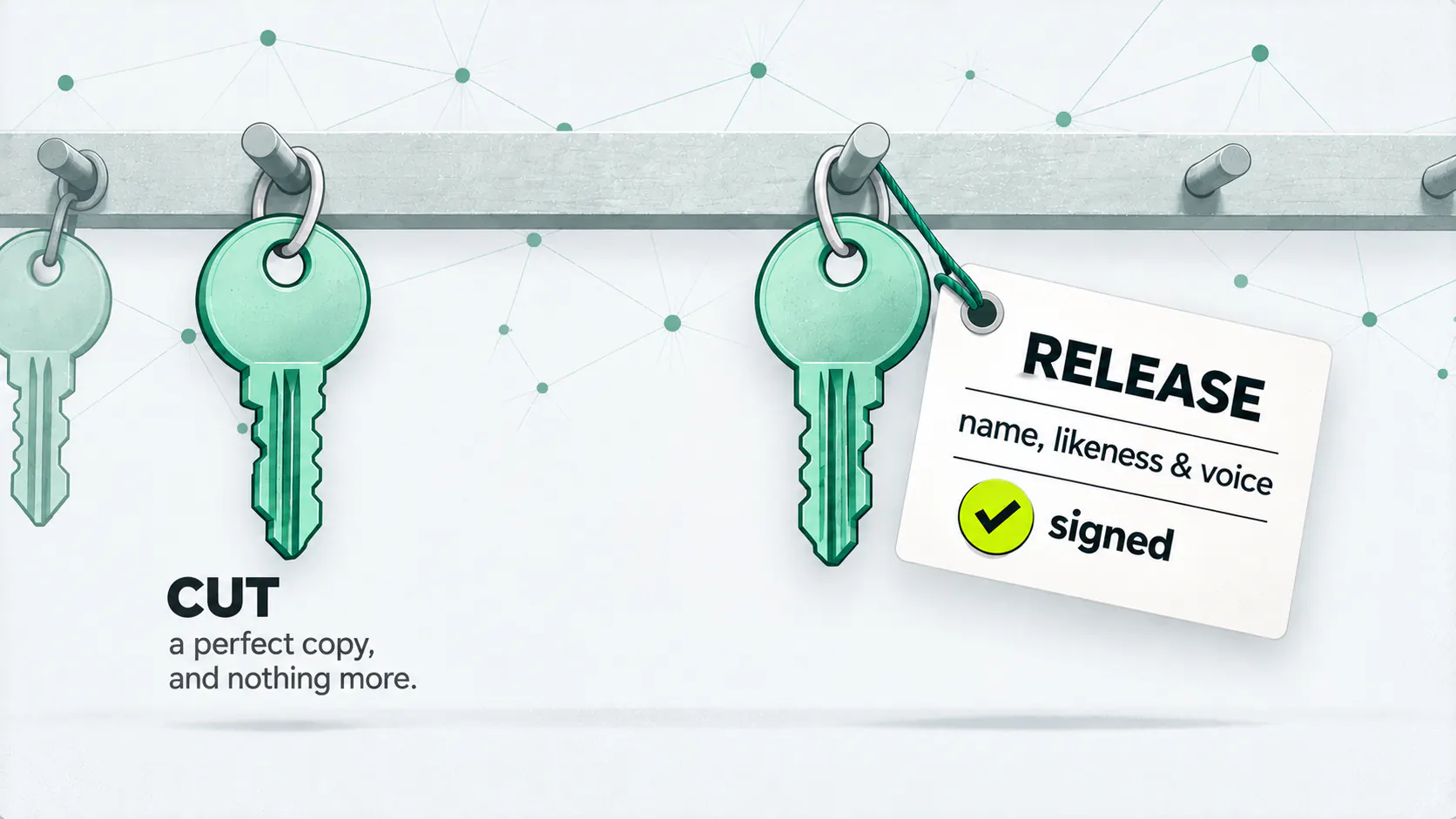
Both states went after the contract, because that is where this gets decided. Since the start of 2025, a clause letting a company use someone's digital replica is unenforceable in California when it does not include a reasonably specific description of the intended uses1 of that replica, and the person had neither a lawyer negotiating for them nor a union agreement that expressly addresses uses of digital replicas1. New York voids the same kind of clause2 on the same two conditions. The catch-all everyone has been signing for years, the one granting use of your likeness in any medium now known or later devised, does not survive either test.
How close does the copy have to be?
Close enough that people would take it for them. California's definition is a computer-generated, highly realistic electronic representation that is readily identifiable as the voice or visual likeness of an individual1, and it covers both a performance the person never gave and one where the fundamental character of the performance or appearance has been materially altered1. New York puts it more plainly: a simulation so close that a layperson would not be able to readily distinguish2 it from the real voice or likeness. Both tests come down to one question: would the audience know?
What if the person has died?
The right outlives them, and the estate holds the pen. California makes anyone who produces or distributes the digital replica of a deceased personality's voice or likeness in an expressive audiovisual work or sound recording without prior consent liable for the greater of ten thousand dollars ($10,000) or the actual damages suffered3. New York reaches the same place through its deceased-performer right: an unauthorized digital replica in an audiovisual work or sound recording carries the greater of two thousand dollars or the compensatory damages4, plus profits. California's statute does carve out news, satire, criticism and documentary work. An ad is none of those.
And the spokesperson that isn't a real person?
Invent the person and the licensing problem disappears, because there is nobody to license. A disclosure duty arrives in its place. New York signed a law in December 2025, in force since June, defining a synthetic performer5 as a digitally created asset made with generative artificial intelligence or a software algorithm and meant to read as a human performer who is not recognizable as any identifiable natural performer5. An advertiser who knowingly runs one has to conspicuously disclose in such advertisement that a synthetic performer is in such advertisement5. The fine is a thousand dollars, then five thousand. Small money. The real cost is a client learning about the obligation after the campaign ships.
Whose face is it?
a real, identifiable person, or nobody at all?
A living person
a release naming the uses, with counsel or the union at the table
Someone who has died
the right outlived them: the estate consents, or it does not run
Nobody real
no likeness to license, but in New York you disclose it
Making the copy is easy in every branch. The paperwork is what separates use from infringement.
What's Real?
- The contract is the control point, and a blanket clause fails it. Both states strike down a digital-replica provision that skips a reasonably specific description of the intended uses1 where the person had no lawyer and no union agreement covering replicas. Name the media, the term and the edits, or the permission you think you bought is not there.
- The test is whether people would know. California asks whether the replica is readily identifiable1 as that person. New York asks whether a layperson would not be able to readily distinguish2 it from the real thing. “We changed it a bit” is not a defense.
- Death does not release the likeness. Running a dead personality's replica without consent costs ten thousand dollars or actual damages3 in California, and two thousand or compensatory damages4 plus profits in New York.
- A fully synthetic face swaps the license for a disclosure duty. New York's rule makes the advertiser conspicuously disclose5 the synthetic performer in the ad itself.
- This is a patchwork of state law, so the working standard is the strictest one your media plan touches. A national campaign reaches California and New York by default.
The “so what” — for anyone serving tech clients
- Put likeness on the clearance checklist, beside music and stock. Before a concept reaches the client, answer two questions: whose face and voice is this, and what did they sign? If the answer to the first is “we generated it,” you still owe an answer to the second.
- Write the named uses into the release. These laws void the catch-all, so name the media, the term, the territory and the kinds of edits you intend, and sign it with counsel or the union at the table. That is now a condition of the permission being real.
- If you go synthetic, design the disclosure into the creative. A label bolted on by a lawyer in launch week looks like a warning; built in from the start, it reads as confidence. The same pattern holds for AI video in general6, where the technology is ready well before the clearances are.
Sources
- California Legislature — AB 2602 (2024), digital replicas in performer contracts (Labor Code § 927)
- New York State Senate — General Obligations Law § 5-302, digital replicas in contracts
- California Legislature — AB 1836 (2024), digital replicas of deceased personalities (Civil Code § 3344.1)
- New York State Senate — Civil Rights Law § 50-f, deceased performers' digital replicas
- New York State Senate — S8420-A (2025), synthetic performer disclosure in advertising
- Cortexa Ground Truth Nº 19 — “AI video is ready for the storyboard, not the shoot”
Next Reads
- Explainer
What “agentic AI” actually means
Agentic AI isn't smarter answers — it's software that takes actions toward a goal. Here's what's real, and why it still needs a human in the loop.
- Explainer
AI doesn’t lie — it guesses
Why Artificial Intelligence (AI) “hallucinates,” in plain English: it isn’t lying — it predicts likely words, and a confident guess can still be wrong.