Cortexa Ground Truth
Nº 12 · Explainer · · 5 min read

Tip: once it’s playing, tap any line to jump the audio there.
MCP is just a universal plug.
“Can the AI use our tools?” The Model Context Protocol (MCP) is the common plug that lets it — one standard port, not a custom wire for every app.
“Can the AI just plug into our tools?” A year ago, that meant building a custom integration for every single app. Now there's a shared answer: the Model Context Protocol (MCP) — a common plug that lets an Artificial Intelligence (AI) assistant talk to your systems without a one-off wire for each one. It's the acronym showing up on every launch this year, so here's the plain version: what it is, what it unlocks, and what's still early.
So what is MCP, exactly?
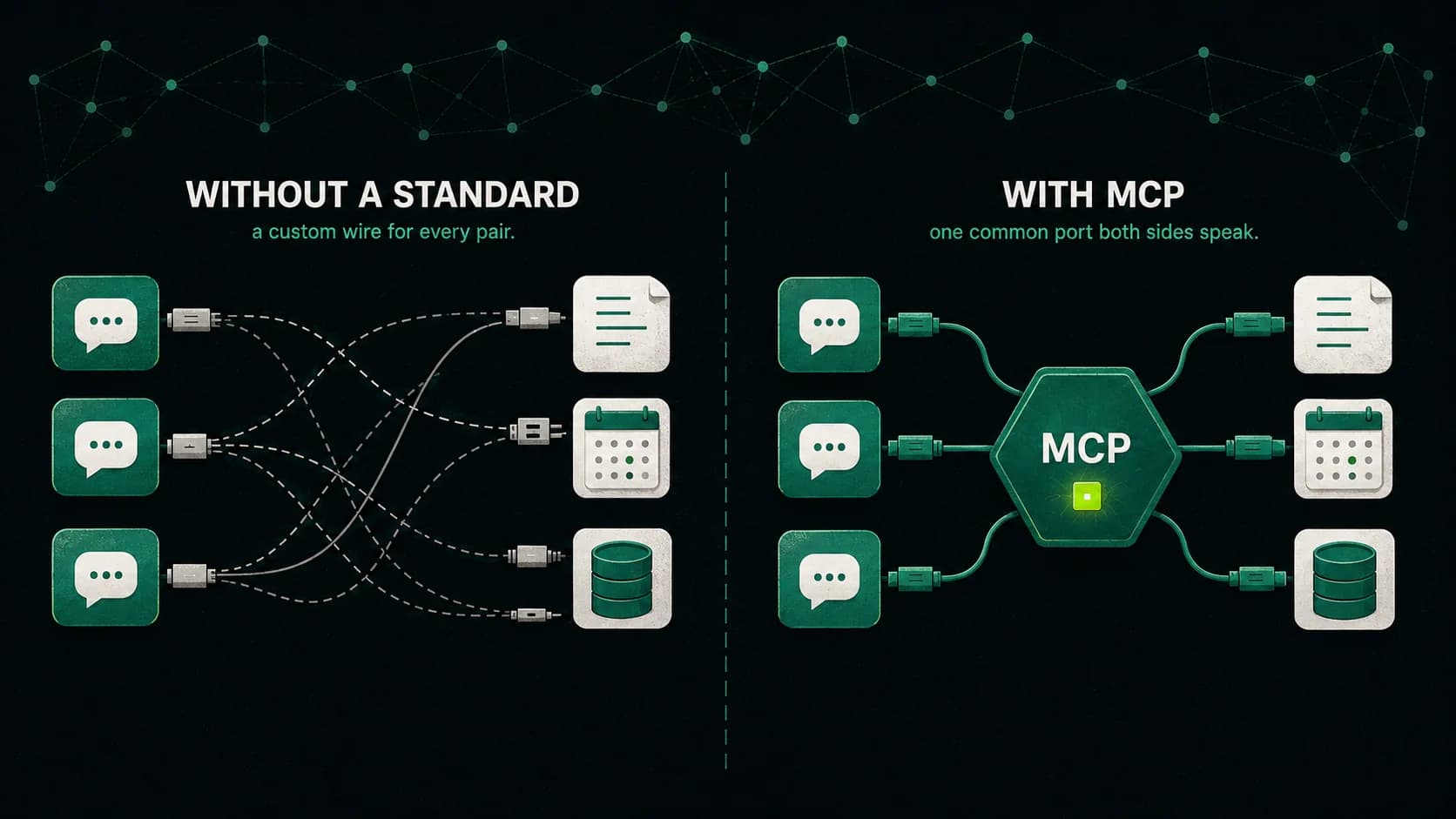
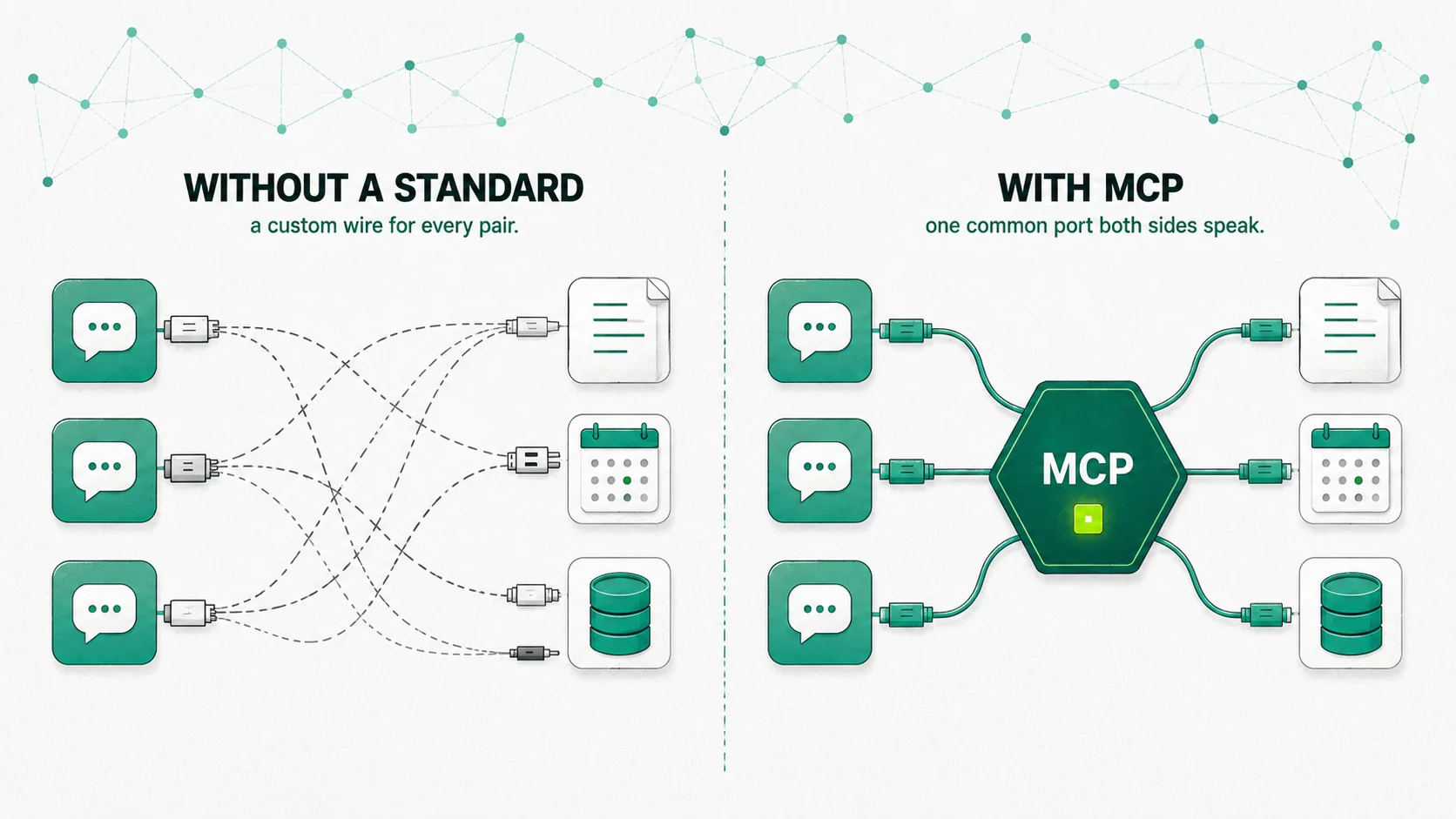
Think of it as a universal port — like Universal Serial Bus Type-C (USB-C), but for AI. Before a standard like USB-C, every device had its own charger and cable, and connecting anything to anything meant a drawer full of adapters. MCP does that same job for AI: instead of hand-building a bespoke connection between every assistant and every tool, both sides speak one shared protocol. Anthropic, which introduced it, describes MCP as a new standard for connecting AI assistants to the systems where data lives1 — your content, your business tools, your dev environment.
Why did this need a standard?
Because without one, integrations don't scale. Every new data source requires its own custom implementation1, so ten apps and ten tools can mean a hundred bespoke connectors to build and maintain. Models end up trapped behind information silos and legacy systems1. MCP replaces that pile of fragmented integrations with a single protocol1: build one MCP connector for your tool, and any MCP-speaking app can use it.
AI app
the assistant with a task
MCP
one shared language both speak
MCP server
a standard adapter for one tool
Your systems
docs, calendar, database
Build the adapter once — every MCP-speaking app can use it.
How settled is the standard?
- It's becoming a shared standard, not one vendor's pet project. Anthropic introduced MCP as an open standard1 and open-sourced it; OpenAI now calls it an open protocol that's becoming the industry standard for extending AI models with additional tools and knowledge2. When rival labs adopt the same plug, that's the signal it's real.
- What it unlocks is practical, not flashy: a model that can actually reach your tool or data. Anthropic frames MCP as secure, two-way connections between their data sources and AI-powered tools1 — the assistant can pull the latest doc, check the calendar, or query the database and act, instead of you copy-pasting context in by hand.
- It is not a free pass to wire everything up. Connecting a model to real tools is exactly where autonomy risk lives — OWASP's “Excessive Agency” guidance for Large Language Model (LLM) apps3 says to scope each tool to the minimum access it needs and to require a human to approve high-impact actions before they are taken3. A plug that reaches your systems is powerful precisely because it reaches your systems.
The “so what” — for anyone serving tech clients
- When a client asks “can the AI connect to our content management system (CMS), our analytics, our calendar?”, MCP is increasingly the answer — and the honest scope is “is there an MCP server for that tool yet, and what should it be allowed to touch?” That's a far cheaper conversation than quoting a custom integration for each one.
- It's a positioning gift. The plumbing is standardizing, so your value moves up a level: deciding what to connect, scoping permissions, and keeping a human on the risky actions. Reaching the tools an agent needs4 is getting commoditized — the judgment around it isn't.
Next Reads
- Explainer
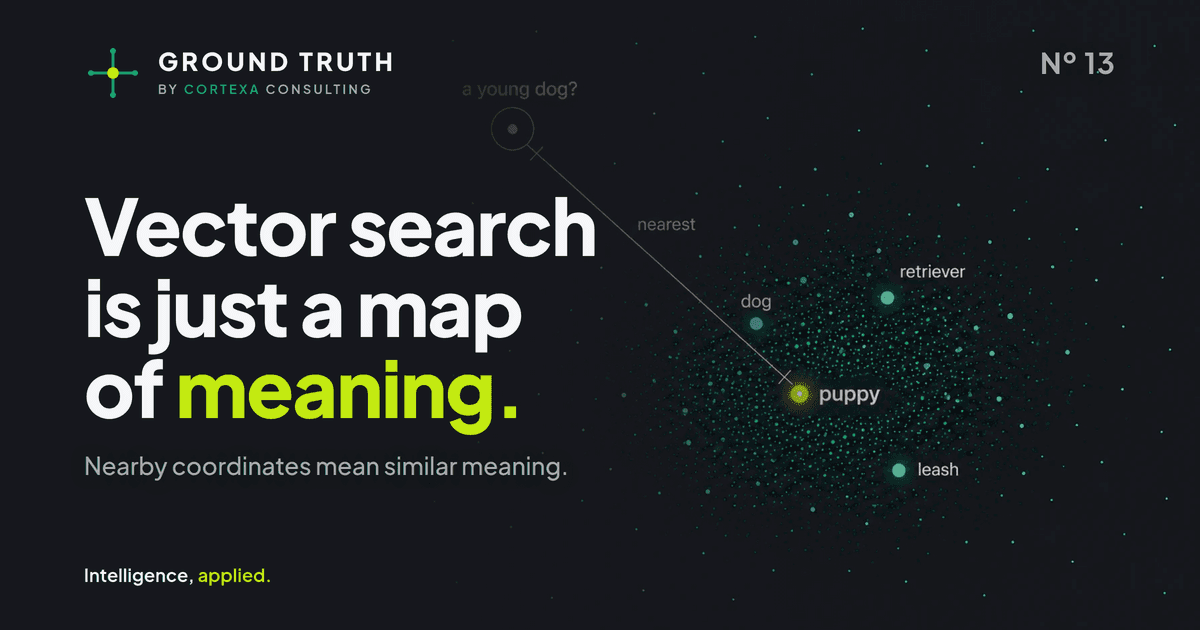
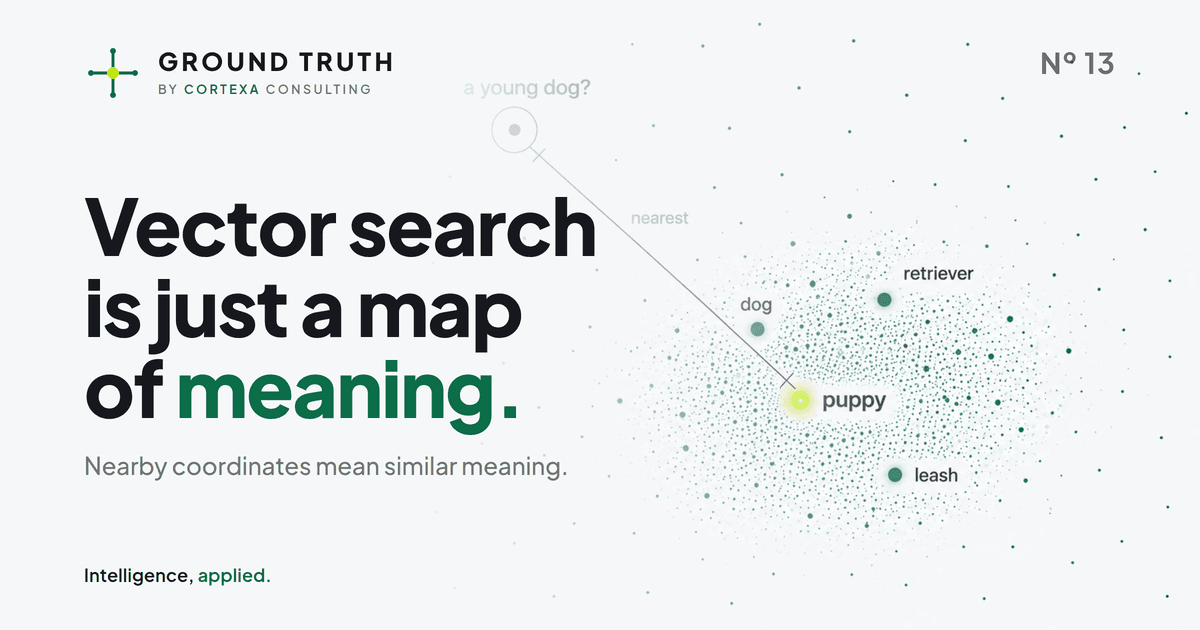
Vector search is just a map of
“Nearby means similar.” Embeddings turn text into coordinates, and a vector database finds the closest ones — the quiet engine behind RAG's open book.
- Explainer
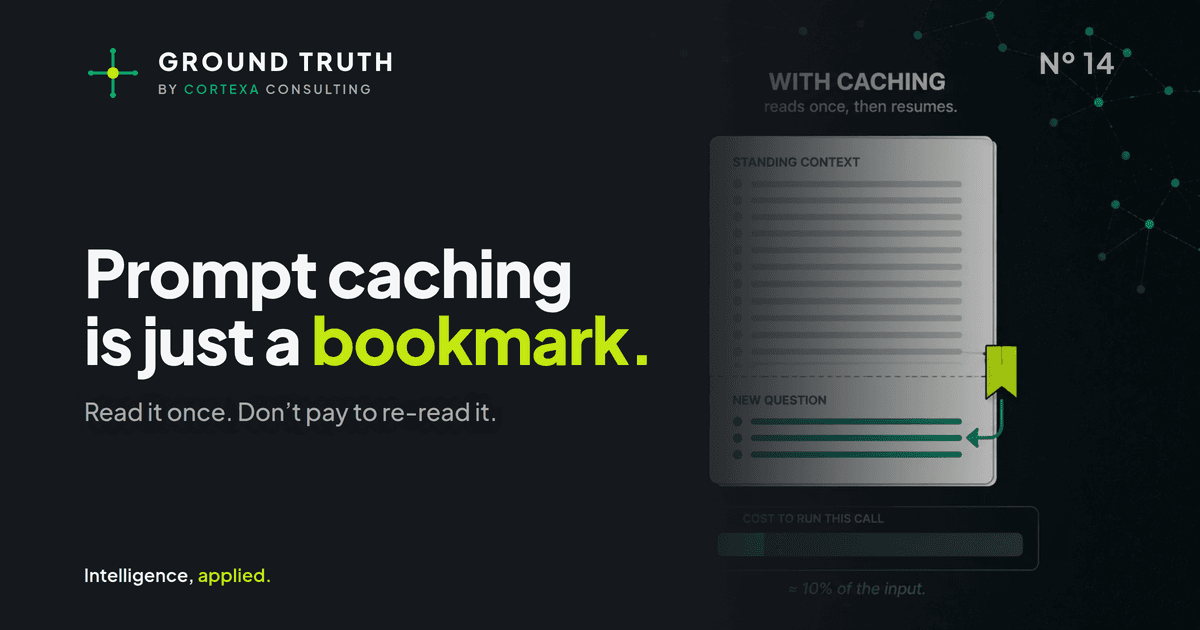
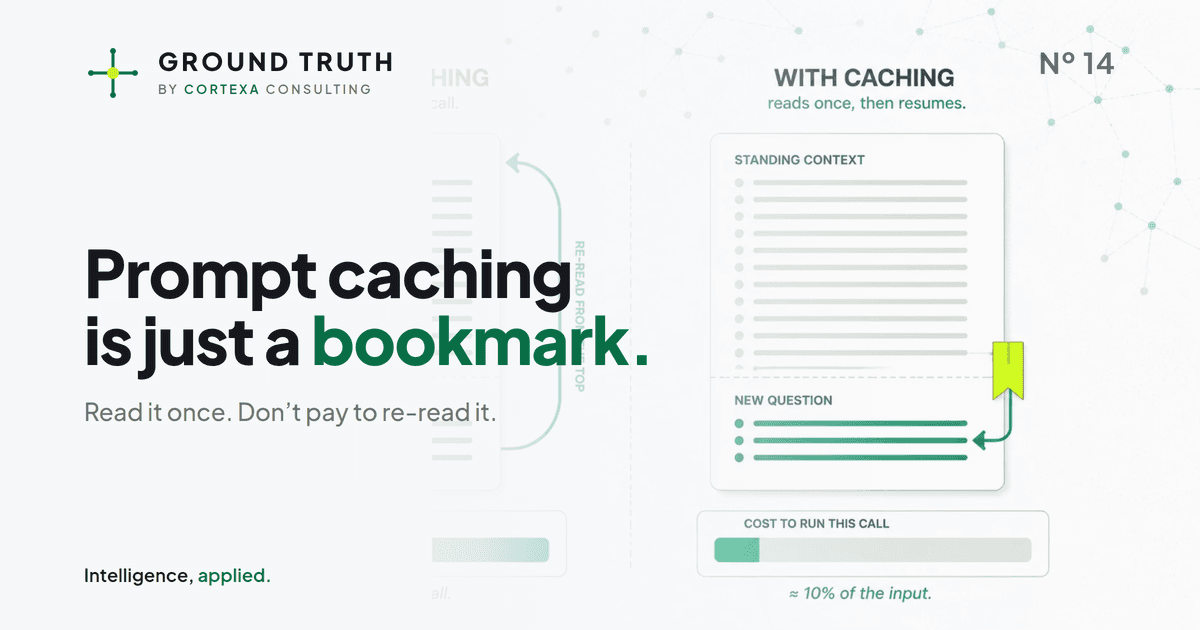
Prompt caching is just a
Models re-read your whole prompt on every call, and bill you each time. Prompt caching reads the repeated part once, then resumes for a fraction.