Cortexa Ground Truth
Nº 6 · Explainer · · 5 min read

Tip: once it’s playing, tap any line to jump the audio there.
“Prompt engineering” is mostly just clear writing.
“Prompt engineering” isn't secret magic words — it's a clear brief. Be specific, give context, show examples: the skill your best writers already have.
“Should we hire a prompt engineer?” It's a fair question — and usually the wrong one. The teams getting good work out of Artificial Intelligence (AI) aren't chanting secret phrases. They're doing something less magical and more familiar: writing a clear brief. A good prompt is a good brief — and that's a skill your best people already have.
Is “prompt engineering” a real skill — or just clear writing?
There's a mystique around it, as if the right incantation unlocks a better model. Here's the part the hype skips: open the actual guidance from the people who build these models and there are no magic words. There's clarity. Be specific about what you want, give the model the context a newcomer would need, and show it a couple of examples of “good.” If that sounds like briefing a sharp new hire, that's exactly right.
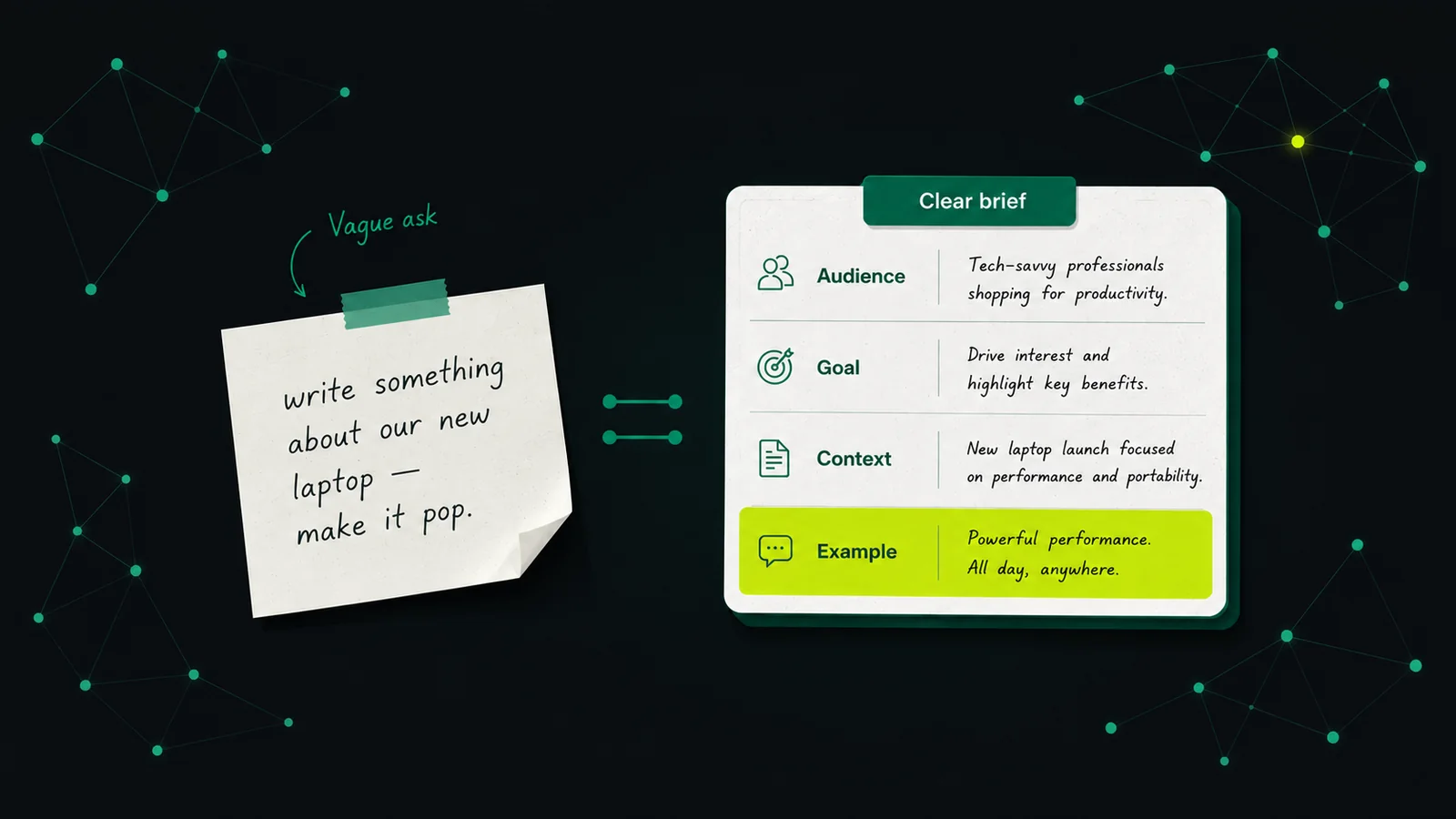
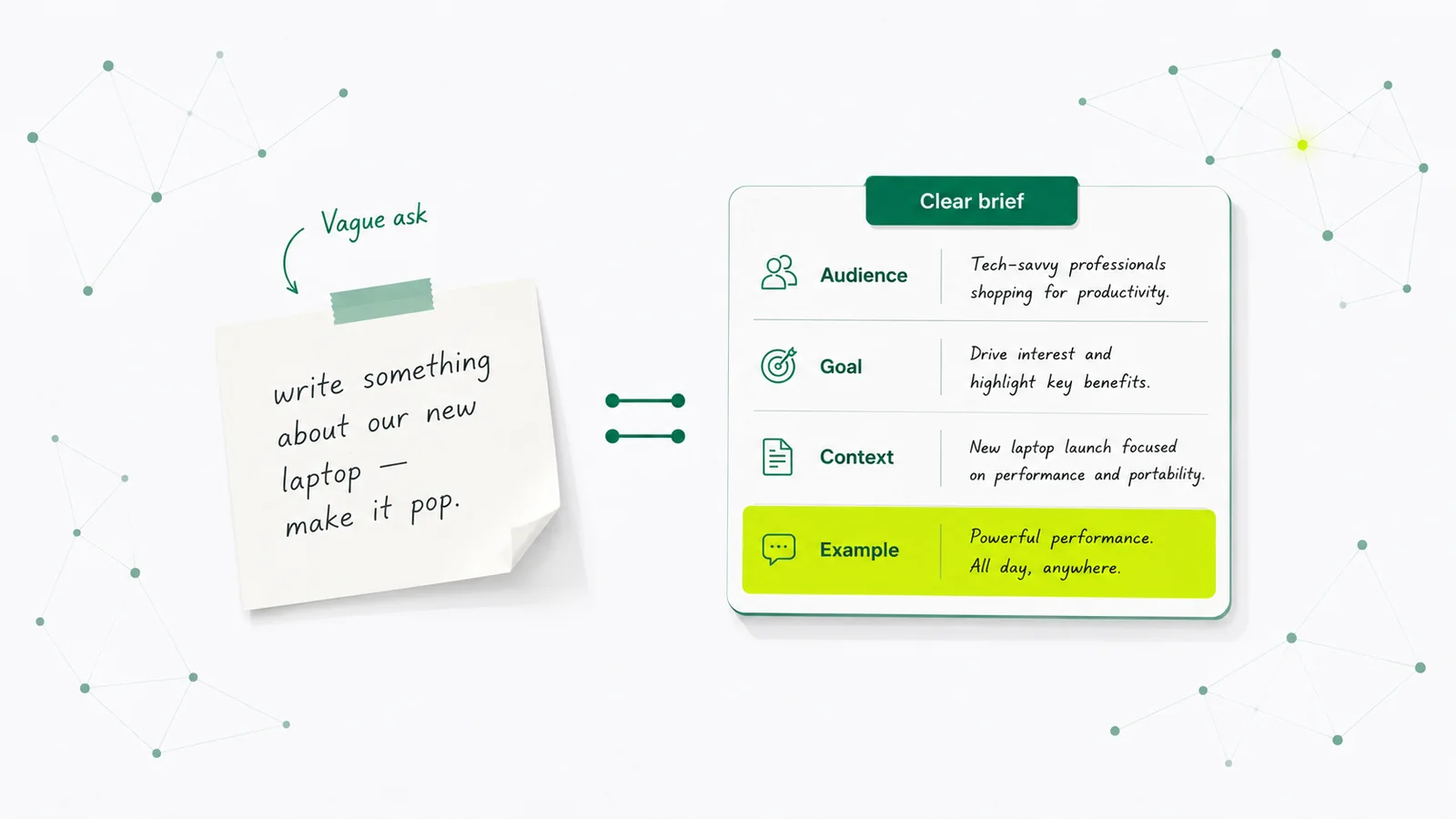
So what actually moves the quality?
Four things — and none of them is a phrase you have to memorize. They're the moves you'd make handing work to a talented freelancer you'll never meet.
Be specific
say what “good” looks like
Give context
who it's for, and why
Show examples
a few samples of the output
Structure it
sections, format, limits
It's a creative brief, not a spell — the clearer the brief, the better the work.
What's actually real?
- Clarity beats cleverness. Anthropic's own guidance boils down to a golden rule: show your prompt to a colleague with minimal context — if they'd be confused, the model will be too1. OpenAI leads with the same move — write clear, detailed instructions2. The model isn't reading your mind; it's a brilliant but new employee who lacks your context.
- Examples are the most reliable lever. Anthropic calls a few well-chosen examples one of the most reliable ways to steer output1, and it isn't new: the foundational few-shot research3 showed that a handful of examples in the prompt let a model take on a task it was never trained for. Show it what “good” looks like and it copies the pattern.
- There's one genuinely non-obvious move: ask it to work step by step. Prompting a model to spell out its reasoning4 measurably improves harder, multi-step answers — though newer “reasoning” models increasingly do this on their own. Even this isn't a magic word; it's “show your work,” the same thing we ask of people.
- The folklore doesn't carry the weight. Threats, tips, flattery, secret prefixes — none of it leads the model-builders' own playbooks, which put clarity, context, and examples first. The unglamorous stuff is the stuff that works.
The “so what” — for anyone serving tech clients
- When a client says “we need a prompt engineer,” reframe it: you need people who can brief a model as clearly as they'd brief a freelancer. That's a coaching problem, not a hiring gap — and your best writers are already most of the way there.
- Build the asset, not the incantation. A curated set of example inputs and on-brand outputs is reusable, teachable, and improves every prompt that uses it — worth far more than any clever phrasing you can't reliably repeat.
Next Reads
- Explainer5 min read
A great demo isn't a shipped product.
A demo proves Artificial Intelligence (AI) can work once. Production means it works every time — safely, at scale. That gap is where most projects stall.
- Explainer5 min read
Evals, in plain English.
An eval is the test you run before an Artificial Intelligence (AI) feature ships — and every time after. It's how good gets measured, not eyeballed.


